


What Are Coding Agents and Why Developers Should Care?
Before building anything, it helps to understand what separates a coding agent from a basic autocomplete tool. An everyday code suggestion tool predicts the next line you are about to write. A coding agent does something fundamentally different: it reasons about your codebase, plans across multiple steps, executes tasks, monitors results, and loops back when something breaks.
You give a coding agent a task like “refactor this module to follow SOLID principles,” and it gets to work independently. It reads relevant files, writes the updated code, runs available checks, and surfaces what changed. That is not autocomplete, that is autonomous execution with contextual awareness.
For developers drowning in repetitive work, writing boilerplate, generating tests, chasing down regression bugs, this kind of intelligent execution is a real shift. Understanding this distinction early is the foundation for using these tools consistently and extracting genuine value from them rather than frustration.
How Coding Agents Fit Into a Real Development Workflow?
One of the most common questions developers ask is: Where do coding agents actually plug into my existing workflow? The answer depends on how you work, but three natural entry points apply to almost every developer immediately.
First, use coding agents for the tasks you dread most: writing tests, generating API documentation, building configuration files, or setting up CI/CD pipelines. These are high-effort, low-creativity jobs where agents deliver reliably. Second, deploy them during code review preparation. Many agents scan a diff, flag potential issues, and suggest improvements before it reaches a teammate, significantly reducing review time. Third, they are excellent for rapid prototyping. Instead of building a proof of concept from scratch, describe the feature and let the agent generate the initial structure. You refine and build on top.
Integrating coding agents at these three stages alone will noticeably accelerate your development cycle without disrupting the workflow you already depend on every day.
Top Use Cases Where Coding Agents Deliver Real Value: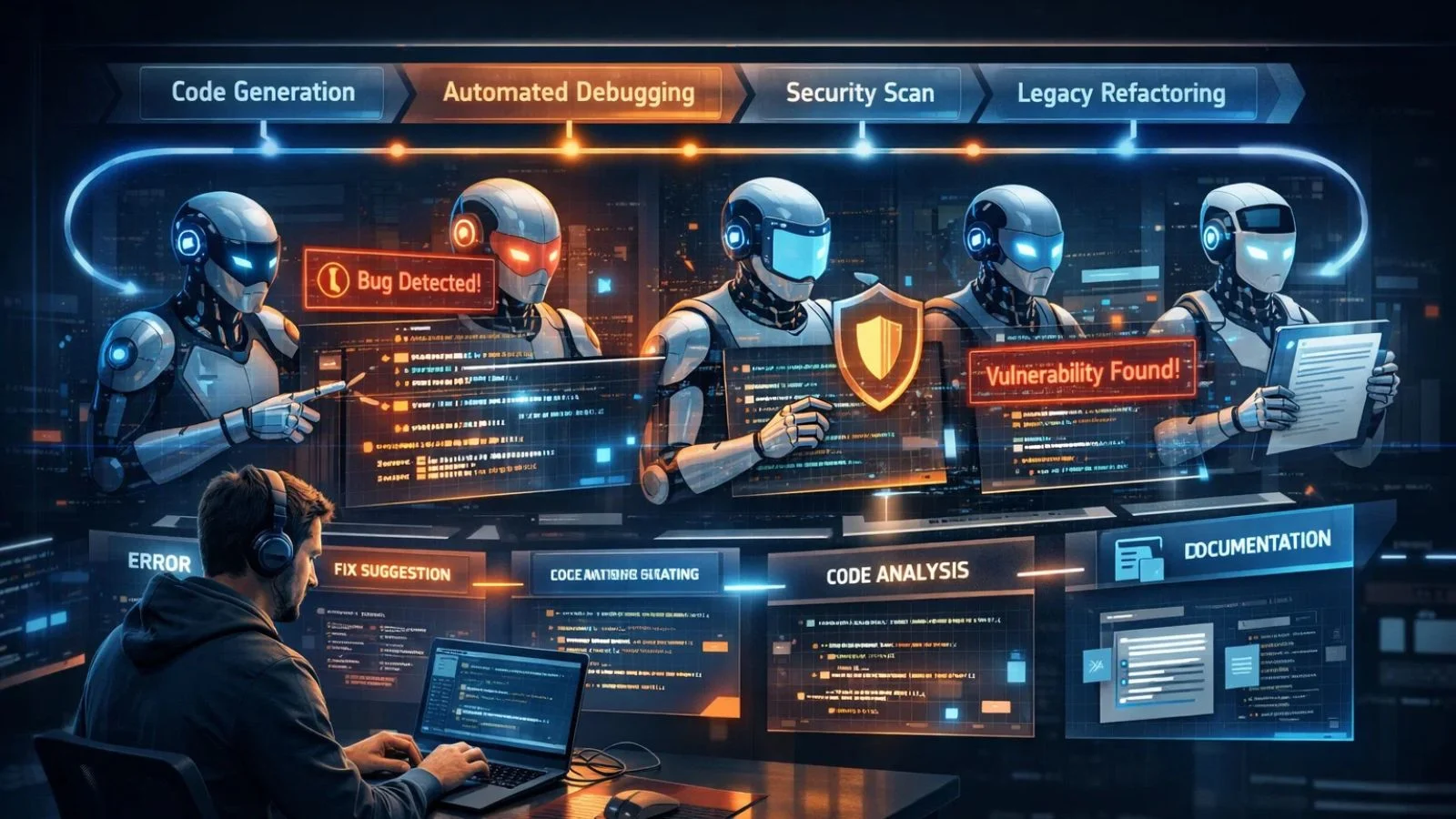
The use cases for coding agents have expanded dramatically. What started as basic code completion has grown into a comprehensive set of capabilities that touch every stage of development.
Automated debugging is the most immediately impactful. Instead of spending hours tracing stack traces manually, an AI coding agent can analyze an error, locate the root cause, and propose a working fix within seconds.
Code generation for repeating patterns, CRUD operations, REST endpoints, and data models saves enormous time across projects of every scale. Legacy refactoring is growing fast as teams managing old codebases realize that manual rewrites would take months that no one has.
Security scanning is increasingly critical, with coding agents flagging exposed credentials, injection vulnerabilities, and insecure dependencies before they reach production. Finally, documentation generation is something developers consistently skip. Still, teams always need, and agents handle it accurately, automatically, and without complaint, making it one of the highest-return tasks you can delegate today.
How to Choose the Right Agentic AI Coding Tools?
Not all coding agents are built the same, and choosing the wrong one quickly wastes time. Evaluating agentic AI coding tools properly before committing comes down to a few key factors.
Start with IDE integration. The best tools are ones that fit naturally into your existing environment, such as S Code, Cursor, JetBrains, or a terminal-based setup. Forced context-switching kills momentum and undermines the productivity gains you are chasing. Next, evaluate multi-file reasoning.
Some agents handle isolated edits well but break down when context spans multiple modules or services. For any codebase beyond a single small project, this matters significantly. Then consider the autonomy level.
Some developers want an agent that suggests and waits for approval. Others prefer end-to-end execution with minimal back-and-forth. Neither is wrong; it depends on your confidence in the tool and how critical the codebase is. Start with more oversight, build trust incrementally, and expand autonomy as consistency improves.
Common Challenges When Building With Coding Agents:
Working with coding agents is powerful, but not frictionless. Recognizing the common challenges early helps you navigate them before they become real problems.
Hallucinations remain the most widely reported issue. An AI agent for coding can write code that looks correct on the surface but contains subtle logic errors or references deprecated APIs. Always review generated code, especially in business-critical paths. Context limitations are another consistent challenge; most agents perform best on well-scoped, clearly defined tasks.
Broad or vague prompts across sprawling codebases produce output that technically runs but misses the actual intent. Prompt quality is something developers frequently underestimate. Vague instructions produce vague results, and learning to write precise, structured prompts takes deliberate practice over time.
Finally, over-reliance is the most underrated risk. Developers who lean too heavily on coding agents can gradually lose touch with the details of their own codebase. Treat agents as capable collaborators, not a replacement for your own understanding, that balance defines confident, sustainable usage.
Best Practices for Getting Consistent Results:
To consistently get strong output from coding agents, you need to be intentional about how you work with them day to day. These habits separate developers who get reliable results from those who give up after a few disappointing outputs.
Write scoped, specific prompts. Instead of “fix this function,” say “refactor this function to handle null inputs without changing the existing return type.” Specificity directly and measurably improves quality.
Maintain a feedback loop. When an agent produces something wrong, understand why before moving on; your prompting instincts sharpen over time through this practice. Pair-program actively. Treat the agent like a junior developer you are reviewing, not a machine running in the background.
This keeps you in the loop without doing all the heavy lifting. Test everything generated. Automated tests are your primary safety net when output quality varies. Finally, building a prompt library, a curated set of prompts that consistently work for your specific stack, is genuinely valuable and worth sharing across your team.
The Future of Coding Agents: What Comes Next:
The trajectory of coding agents points clearly toward deeper, more autonomous involvement in the entire software development lifecycle. Today, most agents operate at the task level, writing a function, fixing a bug, and generating documentation. The next wave is already moving toward something much broader.
Multi-agent systems, where several specialized coding agents collaborate on different parts of a codebase simultaneously, are gaining real traction. One agent handles front-end component generation, another manages API integration, and a third continuously monitors test coverage. The orchestration layer connecting them is getting smarter with every new model release.
Agents that can plan entire features, manage their own subtasks, coordinate with other agents, and adapt based on iterative feedback are crossing from research into production-ready products faster than most developers expect. For anyone building software today, the question is no longer whether to use coding agents; it is how to build the right habits and familiarity now so you are ready for what is already arriving.
Also Read:
15 Powerful AI Coding Assistant Tools
Discover the Best Coding Agents on SaasTrac AI Agents: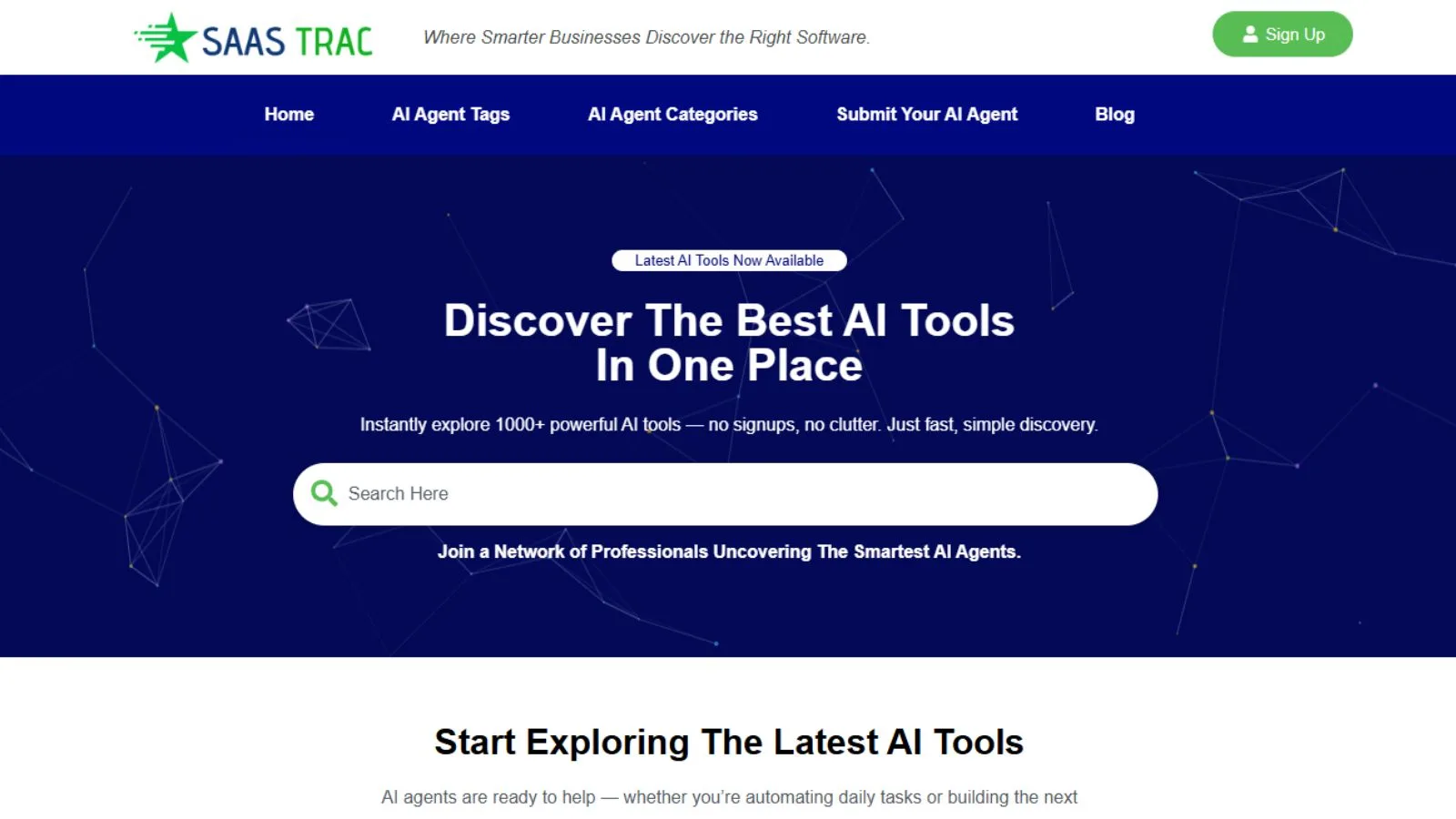
Finding the right tool is half the battle, and that is exactly where SaasTrac AI Agents becomes genuinely valuable. It is a curated directory of 1,000+ AI tools trusted by developers, SaaS founders, and builders worldwide. Fast, structured discovery with zero signups and no clutter.
Here is what makes SaasTrac worth bookmarking:
- 1,000+ AI tools spanning development, automation, productivity, and beyond
- SaasTrac AI Awards 202,6 recognizing top tools with Editor’s Choice, Top AI Tool, and Trending AI Product badges
- Submit Your AI Agent, developers, and vendors can list tools for expert evaluation and community visibility
- Category-based browsing, filter by use case to find tools built specifically for your workflow
- Zero friction access, explore the full directory without paywalls or account creation
Notable tools listed include Agenta (a visual agent builder with drag-and-drop), Emergent AI (mobile agent development), Arize (AI observability and ML monitoring), and the Vercel AI SDK (LLM integration for TypeScript developers).
Conclusion:
Coding agents are no longer optional for developers who want to stay competitive; they are becoming a core part of how modern software gets built. From debugging to documentation, rapid prototyping to legacy refactoring, coding agents remove friction that slows teams down every single day. The key is using them with intention: write precise prompts, review outputs carefully, test consistently, and never stop thinking critically about your own codebase. Start with one workflow, build confidence, and scale from there. Developers who invest in mastering coding agents today will lead the teams of tomorrow.
FAQ’s:
Q1: What is the difference between a coding agent and a standard code autocomplete tool?
Ans: A coding agent plans, reasons, and executes multi-step tasks autonomously, like refactoring a module or writing and running tests end-to-end. An autocomplete tool simply predicts the next line. The difference is independent execution versus passive suggestion.
Q2: Are coding agents beginner-friendly?
Ans: Yes. Many coding agents explain what they generate step by step, which helps newer developers learn patterns, spot best practices, and understand why certain approaches work, making them valuable both as productivity tools and learning companions.
Q3: Will coding agents replace software developers?
Ans: No. They amplify what developers can do but cannot replicate human creativity, architectural thinking, stakeholder communication, or nuanced problem-solving. Think of them as a highly capable assistant, not a substitute for developer judgment.
Q4: How do I ensure the code a coding agent generates is safe to use?
Ans: Treat every output like a pull request from a junior developer. Review it, run your test suite against it, and pay close attention to business-critical logic and any references to external APIs or security-sensitive operations.
Q5: Where is the best place to discover and compare coding agents available today?
Ans: SaaSTrac AI Agents at aiagents is one of the strongest starting points: 1,000+ curated AI tools with category filters, expert reviews, and award-winning products, all accessible without signing up.