

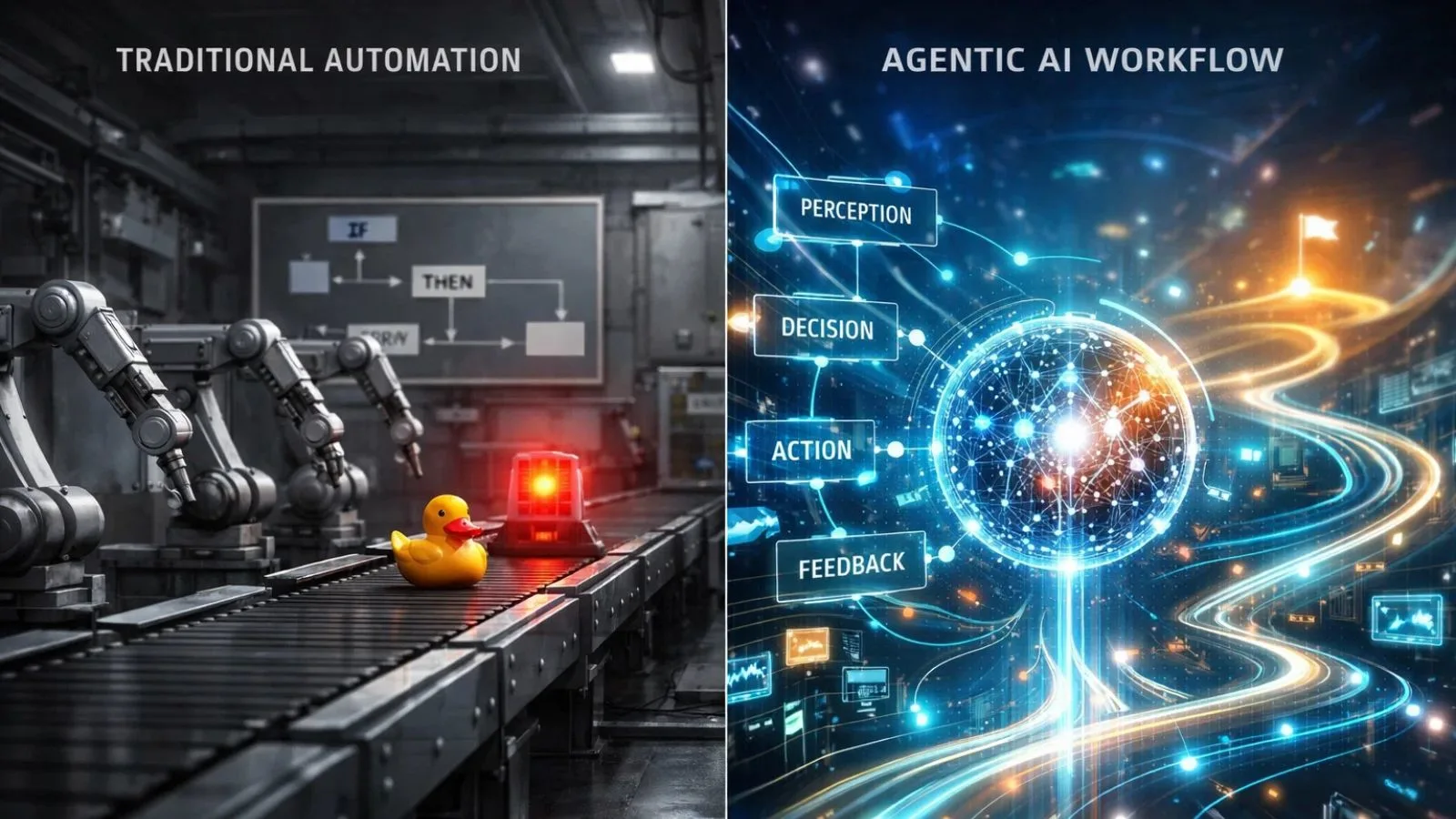
The rise of artificial intelligence has brought transformative changes to how businesses operate, and at the forefront of this revolution is the agentic AI workflow. Unlike traditional automation that follows rigid, predefined rules, these intelligent systems can make decisions, adapt to changing circumstances, and execute complex tasks with minimal human intervention.
As organizations seek to maximize efficiency and reduce operational overhead, understanding how to build and implement these workflows has become essential for staying competitive in today’s fast-paced digital landscape. The shift from reactive to proactive automation represents a fundamental change in how we approach business processes.
Traditional systems wait for instructions, but agentic AI workflow solutions anticipate needs, solve problems independently, and continuously learn from their interactions. This guide will walk you through everything you need to know to create your first intelligent automation system, from understanding core concepts to practical implementation strategies.
Understanding Agentic AI Workflows:

Core Components of an Agentic AI Workflow:
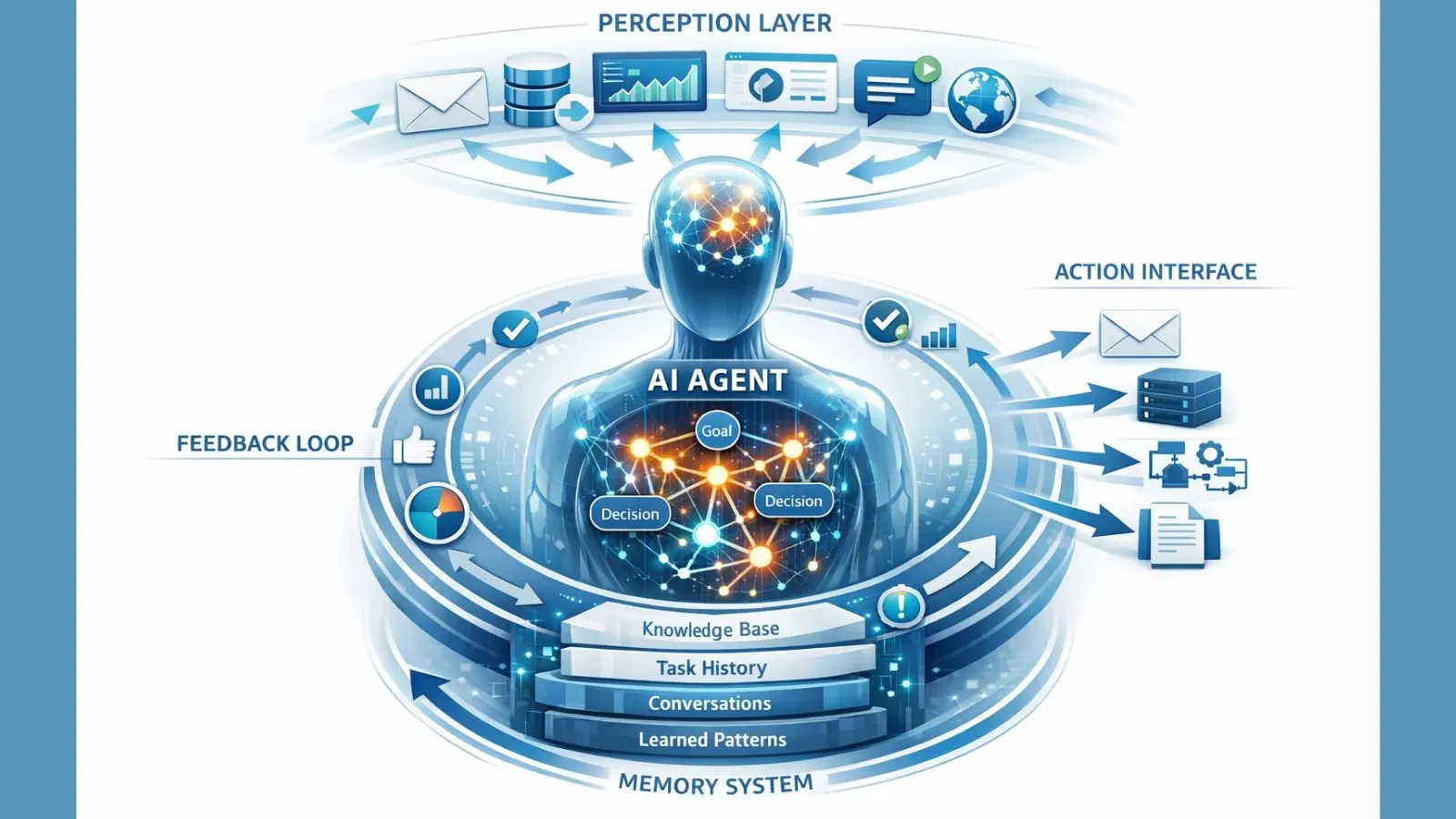
Building an effective agentic AI workflow requires understanding its fundamental building blocks. Each component plays a vital role in creating a system that can operate independently while delivering reliable results.
1. The Perception Layer:
The perception layer serves as the sensory system of your agentic AI workflow, gathering information from various sources. This might include monitoring email inboxes, tracking database changes, analyzing customer interactions, or processing real-time data feeds. The quality of your perception layer directly impacts how well your agent understands its operating environment and makes informed decisions.
2. The Reasoning Engine:
At the heart of every agentic AI workflow lies the reasoning engine, typically powered by large language models or specialized AI systems. This component analyzes perceived information, evaluates potential actions, and determines the best course forward based on established goals and constraints. Modern reasoning engines can handle complex logic, understand nuanced contexts, and even explain their decision-making processes.
3. The Action Interface:
Once decisions are made, the action interface executes them in the real world. This might involve sending communications, updating databases, triggering other systems, or generating content. The action interface transforms abstract decisions into concrete outcomes, serving as the hands and voice of your agentic AI workflow.
4. The Memory System:
Effective agents require memory to maintain context across interactions and learn from past experiences. This component stores conversation history, tracks completed tasks, remembers user preferences, and accumulates knowledge over time. Memory enables your agentic AI workflow to provide personalized, context-aware responses and avoid repeating past mistakes.
5. The Feedback Loop:
Continuous improvement depends on incorporating feedback mechanisms that allow your agentic AI workflow to evaluate its performance. This includes monitoring success metrics, collecting user feedback, identifying failure patterns, and adjusting strategies accordingly. The feedback loop ensures your system evolves and becomes more effective over time.
Planning Your First Agentic AI Workflow:
Success in building an agentic AI workflow starts with careful planning. Jumping straight into implementation without a clear strategy often leads to systems that solve the wrong problems or fail to deliver meaningful value.
1. Identifying the Right Use Case:
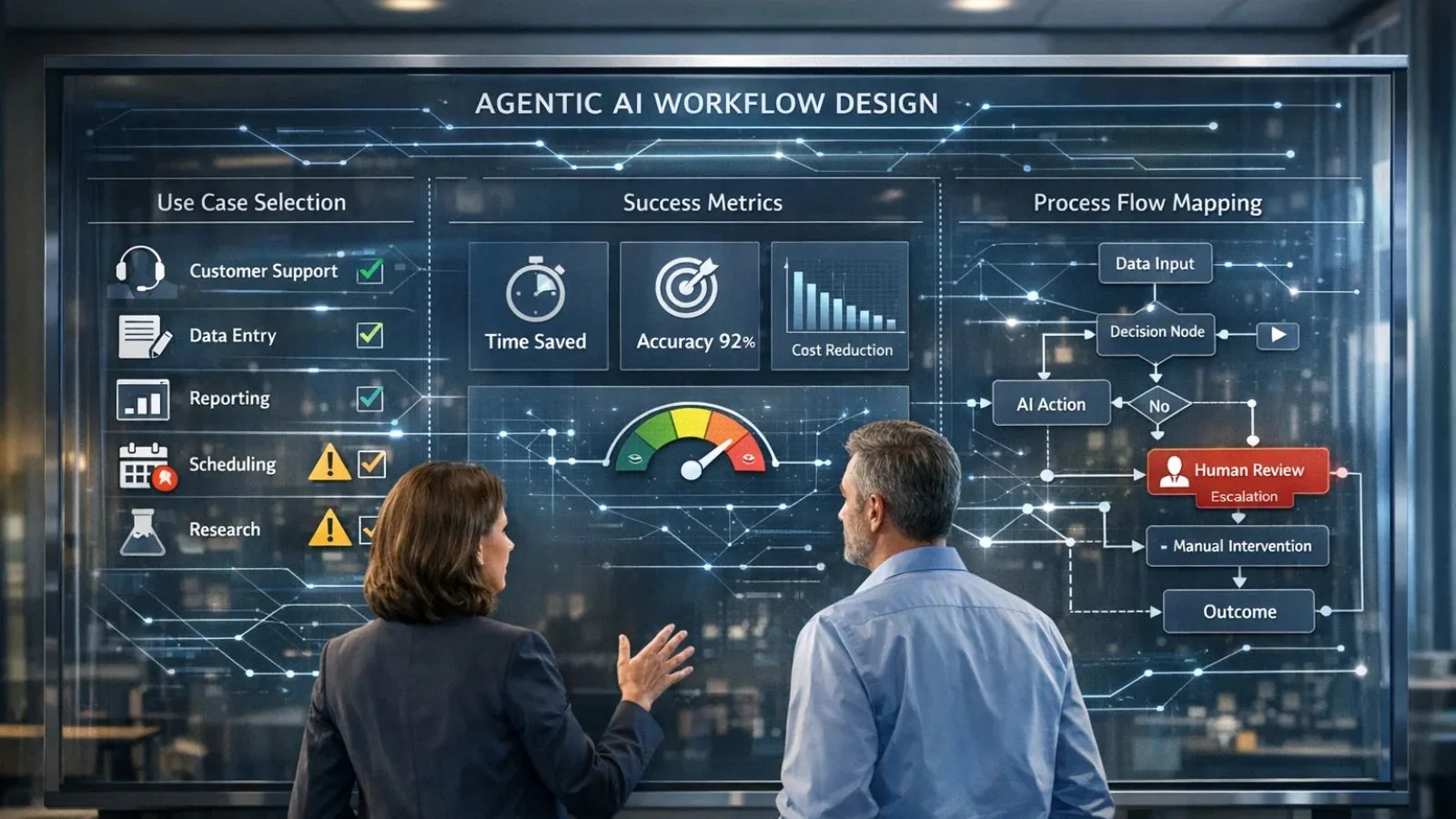
Start by identifying processes in your organization that are repetitive, time-consuming, and follow somewhat predictable patterns but require occasional decision-making. Customer support triage, data entry and validation, report generation, appointment scheduling, and basic research tasks make excellent candidates for your first agentic AI workflow.
Avoid starting with mission-critical processes or those requiring highly specialized domain expertise. Your first project should offer clear value while providing room for learning and iteration without risking significant business disruption.
2. Defining Success Metrics:
Establish concrete measurements for evaluating your agentic AI workflow performance. These might include time saved per task, accuracy rates, user satisfaction scores, cost reduction, or volume of tasks handled. Clear metrics help you assess whether your implementation meets objectives and guide optimization efforts.
3. Mapping the Process Flow:
Document the current process you’re automating in detail. Identify decision points where the agent will need to choose between different paths, information sources it will need to access, actions it should be capable of performing, and escalation triggers for situations requiring human intervention. This AI workflow mapping creates a blueprint for implementation.
Building Your Agentic AI Workflow: Step-by-Step:
With planning complete, you’re ready to begin construction. This systematic approach minimizes complications and ensures you build a robust, maintainable system.
Step 1: Choose Your Foundation:
Select the technology stack for your agentic AI workflow. Popular options include LangChain or LlamaIndex for orchestration, OpenAI GPT-4, Anthropic Claude, or other LLMs for reasoning, vector databases like Pinecone or Weaviate for memory, and API integration tools for connecting external systems.
Your choice should balance capability, ease of use, cost considerations, and integration with existing infrastructure. Many developers start with established frameworks that handle common patterns, allowing them to focus on business logic rather than infrastructure.
Step 2: Implement the Perception Layer:
Create mechanisms for your agentic AI workflow to gather necessary information. This typically involves setting up API connections to relevant systems, configuring webhooks or polling mechanisms for real-time updates, implementing data preprocessing to clean and structure incoming information, and establishing protocols for handling different data types.
Robust error handling is essential at this stage. Your perception layer should gracefully manage situations where data sources are temporarily unavailable or return unexpected formats.
Step 3: Design the Reasoning Logic:
Configure your AI agent workflows with clear instructions about its role, objectives, and constraints. This typically takes the form of a system prompt that establishes the agent’s identity and purpose, defines the boundaries of its decision-making authority, provides examples of correct behavior, and outlines escalation procedures.
Effective prompt engineering significantly impacts performance. Invest time in testing different instruction formats and refining based on results.
Step 4: Build the Action Layer:
Implement the tools and functions your agentic AI workflow can use to accomplish tasks. Each action should have clear documentation about what it does, required parameters, expected outcomes, and potential error conditions. Start with a focused set of capabilities and expand as you validate the core functionality.
Step 5: Implement Memory and Context:
Add systems for maintaining context across interactions. This might involve storing conversation history in a database, creating embeddings of important information for semantic retrieval, implementing caching for frequently accessed data, or tracking user preferences and past decisions.
Memory transforms one-off interactions into coherent, contextual experiences that feel more intelligent and personalized.
Step 6: Test and Iterate:
Thoroughly test your agentic AI workflow with realistic scenarios before deployment. Create test cases covering normal operations, edge cases and unusual inputs, error conditions, and chain-of-thought reasoning quality. Monitor how the agent handles ambiguity and whether it makes appropriate escalation decisions.
Testing reveals gaps in your implementation and opportunities for improvement before real users encounter issues.
Also Read:
Streamlining Implementation with SaasTrac AI Agents:
While building an agentic AI workflow from scratch provides valuable learning and customization opportunities, many organizations benefit from platforms that accelerate development and reduce technical complexity. SaasTrac AI Agents offers a comprehensive solution for teams looking to implement intelligent automation quickly and effectively.
SaasTrac provides pre-built components for common agentic process automation scenarios, allowing you to focus on business logic rather than infrastructure. The platform includes ready-to-use integrations with popular business tools, visual workflow designers that make complex logic accessible to non-developers, built-in memory and context management systems, and monitoring dashboards that track agent performance and identify optimization opportunities.
What sets SaasTrac apart is its focus on enterprise-grade reliability and scalability. The platform handles the challenging aspects of agentic AI workflow implementation, such as managing conversation state across distributed systems, implementing robust error handling and recovery mechanisms, optimizing LLM costs through intelligent caching and prompt management, and ensuring security and compliance with data handling regulations.
For teams building their first Agentic Workflows, SaasTrac dramatically reduces time-to-value. Instead of spending weeks building infrastructure, you can deploy functional agents in days. The platform’s templates cover common use cases like customer support automation, data processing pipelines, content generation workflows, and research and analysis tasks.
SaasTrac also excels at scaling from prototype to production. Many organizations struggle when transitioning from a working demo to a system that handles real user load reliably. SaasTrac’s infrastructure automatically scales with demand, maintains consistent performance under varying loads, and provides the observability tools needed to maintain production systems confidently.
Best Practices for Agentic AI Workflow Success:
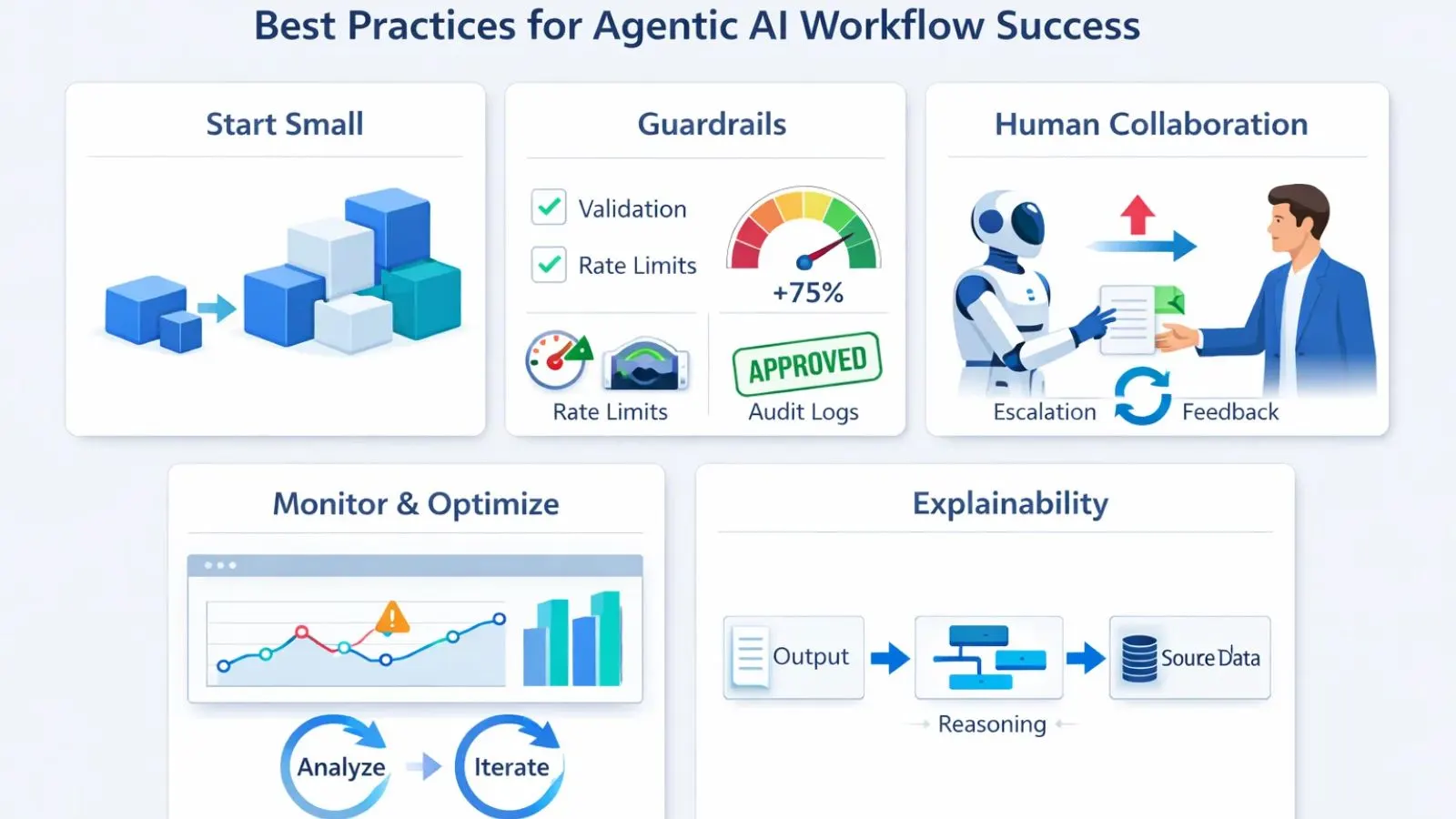
Implementing your first agentic AI workflow successfully requires following established best practices that help you avoid common pitfalls and maximize value.
1. Start Small and Focused:
Resist the temptation to build an agent that handles everything. Begin with a narrowly defined problem where you can clearly measure success. Once you’ve proven value and learned from real-world usage, expand capabilities incrementally. This approach builds confidence and demonstrates ROI quickly.
2. Implement Guardrails and Constraints:
Your agentic AI workflow needs clear boundaries to operate safely. Implement validation checks on agent outputs before taking actions, rate limiting to prevent runaway processes, approval workflows for high-stakes decisions, and audit logging to track all agent activities for compliance and debugging.
These guardrails prevent small errors from becoming significant problems and maintain trust in your automated systems.
3. Design for Human Collaboration:
The most effective AI agent workflows complement human capabilities rather than replacing them entirely. Design your system to escalate complex or ambiguous situations to human experts, provide transparency into decision-making processes, accept feedback and corrections gracefully, and learn from human interventions to improve over time.
This collaborative approach leverages the strengths of both human judgment and AI efficiency.
4. Monitor and Optimize Continuously:
Deployment isn’t the finish line; it’s the starting point for improvement. Regularly review performance metrics against established baselines, analyze failure cases to identify improvement opportunities, gather user feedback about agent interactions, and update prompts and logic based on real-world learnings.
Successful agentic AI workflow implementations evolve continuously based on operational experience.
5. Prioritize Explainability:
Users need to understand why your agent makes specific decisions. Implement logging of reasoning processes, provide clear explanations when presenting results, document the logic behind automated actions, and make it easy to trace decisions back to source information.
Explainability builds trust and makes debugging significantly easier when issues arise.
Overcoming Common Challenges:
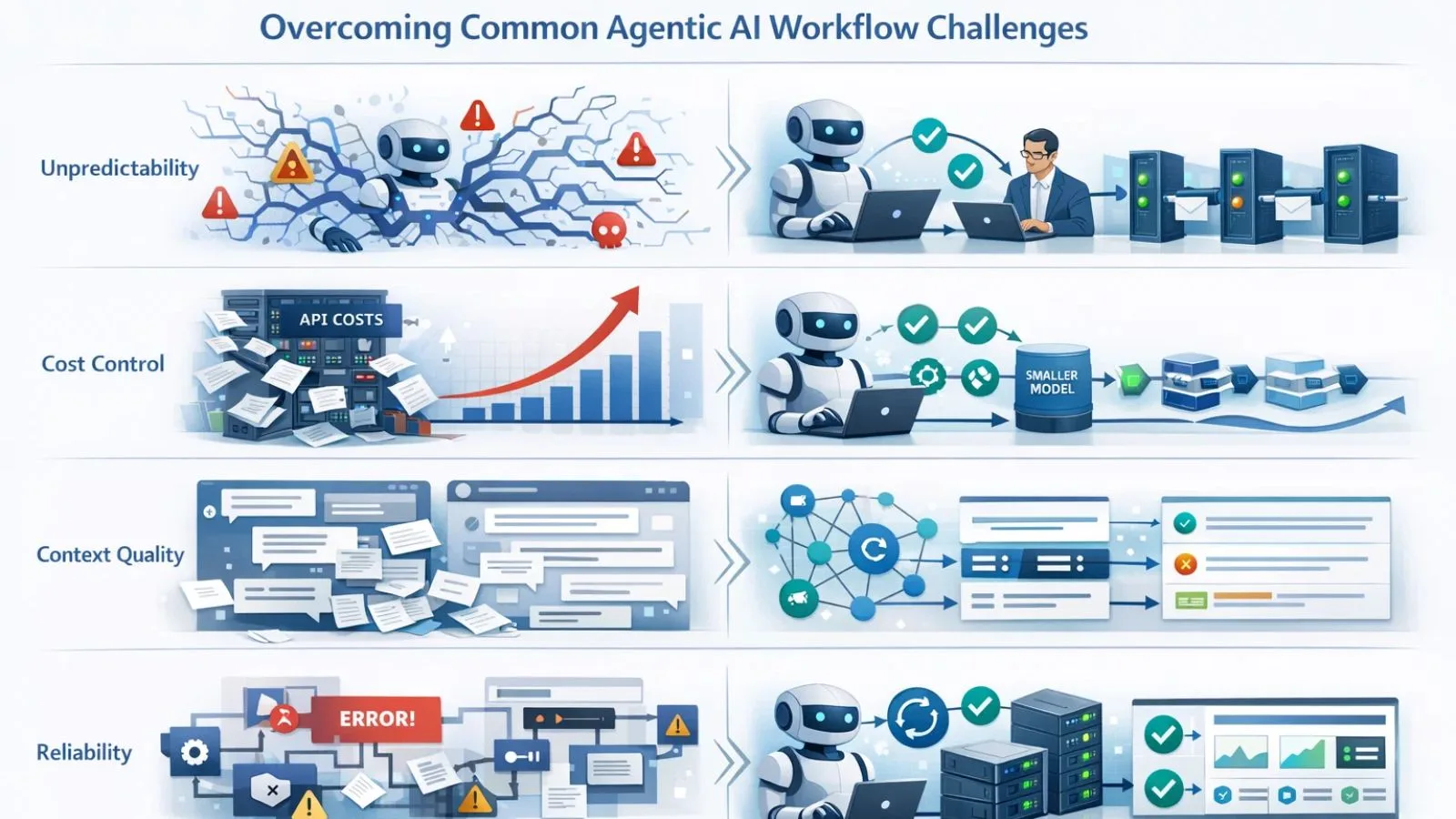
Every team building their first agentic AI workflow encounters obstacles. Understanding these challenges in advance helps you prepare effective responses.
1. Managing Unpredictability:
AI systems can produce unexpected outputs, especially when handling novel situations. Mitigate this through comprehensive testing across diverse scenarios, implementing output validation before taking actions, starting with lower-stakes use cases, and maintaining human oversight during initial deployment phases.
2. Controlling Costs:
LLM API calls can become expensive at scale. Optimize costs by implementing caching for repeated queries, using smaller models for simpler tasks, batching requests when possible, and monitoring usage patterns to identify optimization opportunities. Effective agentic AI workflow design balances capability with cost efficiency.
3. Maintaining Context Quality:
As conversations extend, maintaining relevant context becomes challenging. Address this through implementing semantic search over conversation history, periodically summarizing long interactions, identifying and preserving critical information while discarding irrelevant details, and testing context handling with realistic conversation lengths.
4. Ensuring Reliability:
Users expect consistent performance from automated systems. Build reliability through comprehensive error handling at every integration point, implementing retry logic with exponential backoff, monitoring system health and alerting on anomalies, and maintaining fallback options when primary systems fail.
Conclusion:
Building your first agentic AI workflow represents an exciting step toward more intelligent, efficient operations. By understanding core concepts, following systematic implementation approaches, and learning from established best practices, you can create systems that deliver genuine business value while providing room for growth and evolution.
Remember that success comes through iteration. Your first implementation will reveal insights that inform improvements, and each enhancement builds toward increasingly sophisticated automation. Whether you build from scratch or leverage platforms like SaasTrac, the key is starting with clear objectives, measuring results honestly, and committing to continuous refinement.
The future of work involves humans and intelligent agents collaborating seamlessly. By mastering agentic AI workflow development today, you position yourself and your organization to thrive in this emerging landscape.
FAQ’s:
Q1: How long does it take to build a functional agentic AI workflow?
Ans: Timeline varies based on complexity, but a focused first project typically takes 2-4 weeks from planning to initial deployment when using modern frameworks or platforms.
Q2: Do I need machine learning expertise to build an agentic AI workflow?
Ans: While helpful, it’s not required. Modern tools and platforms abstract much of the complexity. Understanding prompt engineering and system design is more important than deep ML knowledge.
Q3: What’s the typical ROI for agentic AI workflow implementation?
Ans: Most organizations see positive ROI within 3-6 months through time savings, error reduction, and increased capacity. The exact return depends on the process automated and the implementation quality.
Q4: How do I handle situations where the agent makes mistakes?
Ans: Implement feedback mechanisms, human review for high-stakes decisions, and continuous monitoring. Use mistakes as learning opportunities to refine prompts and improve logic.