

Selling digital products internationally creates responsibilities that go far beyond accepting a customer’s payment.
VAT, GST, sales tax, fraud, chargebacks, subscription billing, and local payment requirements can all change depending on where the buyer is located. Managing those obligations internally becomes increasingly difficult as a business enters more markets.
Merchant of Record providers solve this by becoming the legal seller of the transaction and handling much of the payment and tax infrastructure on the merchant’s behalf.
The four providers below approach that job differently. Some focus on straightforward global SaaS sales, others specialize in software distribution or high-volume subscription billing, while newer platforms are being built around AI and usage-based monetization.
Best Merchant of Record Providers by Use Case
| Provider | Best Use Case | Founded | Pricing |
| Fungies.io | Global SaaS subscriptions and digital product sales | 2022 | 5% + $0.50 per transaction |
| Lemon Squeezy | Software and digital products with tax compliance needs | 2020 | 5% + $0.50 per transaction |
| Paddle | Established SaaS and subscription businesses | 2012 | Custom pricing |
| Polar | AI startups and usage-based SaaS products | 2022 | Custom pricing |
These providers were evaluated using publicly available product information, user reviews, and published case studies.
1. Fungies.io – Best for Global SaaS Subscriptions and Digital Product Sales
Platform Profile
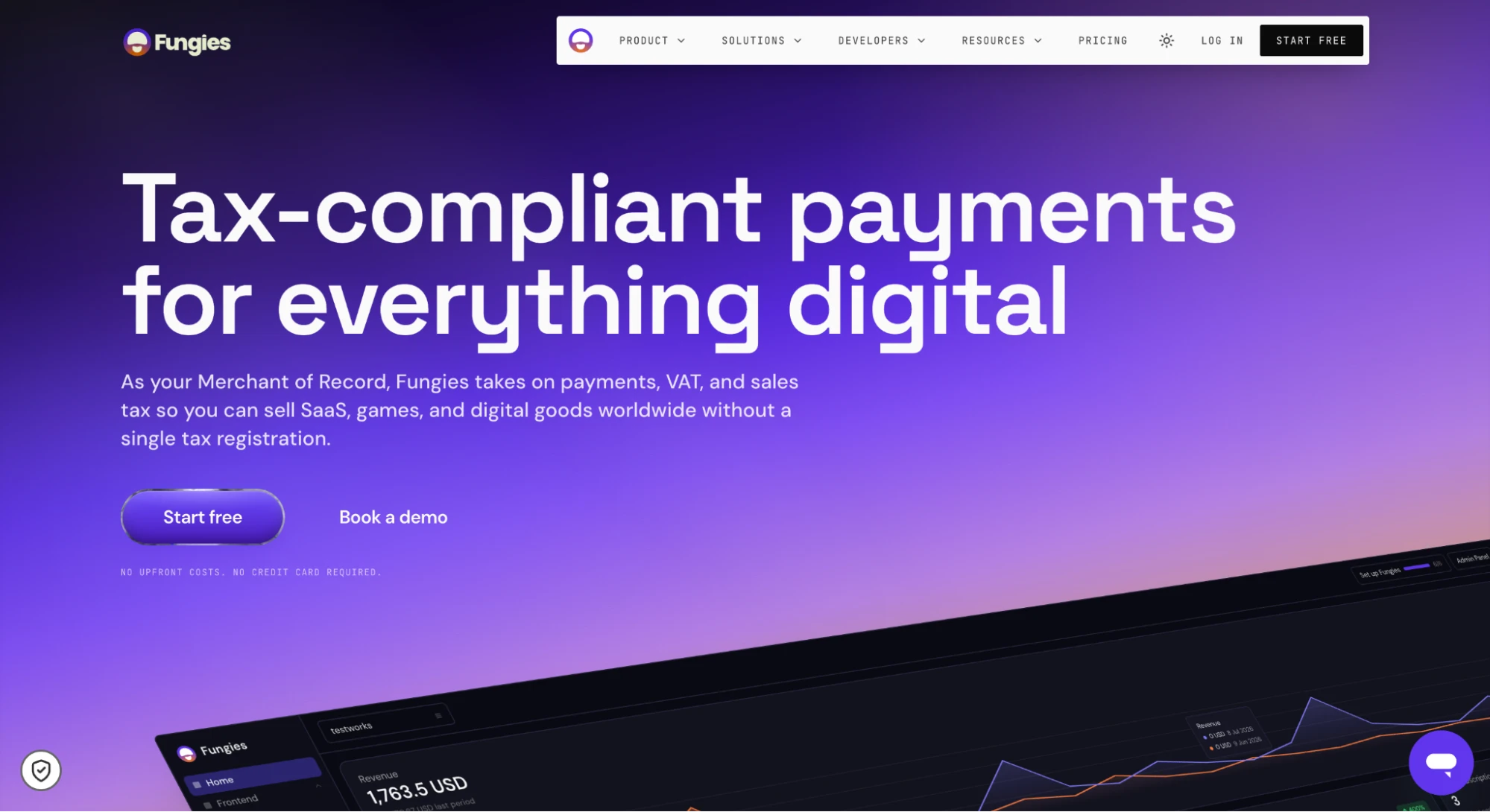
Fungies.io is a Merchant of Record platform for SaaS companies, digital creators, and game studios selling internationally.
It combines checkout, subscription billing, and global tax compliance under one integration, with VAT, GST, and sales tax coverage across more than 150 countries.
Pricing is 5% + $0.50 per transaction with no monthly fee.
The platform also provides CLI and MCP integrations for development teams and reportedly allows merchants to get started in under 15 minutes.
Key Strengths
The strongest part of Fungies.io’s offering is consolidation.
International SaaS companies can otherwise end up combining different providers for:
- Payments
- Subscription billing
- VAT and GST
- Sales tax
- Checkout
- Merchant compliance
Fungies.io brings these areas into one platform instead of requiring several separate integrations.
The transaction-based pricing structure can also be easier for early-stage companies to model because there is no additional monthly platform fee.
Evidence and Merchant Feedback
Fast setup and responsive support appear consistently in available customer feedback.
Teams including Leadsin.io and RenderAI.app have also highlighted storefront flexibility and the benefit of paying one transaction-based fee rather than maintaining several separate software subscriptions.
What to Consider
Fungies.io is a newer provider than platforms such as Paddle.
Businesses that place greater importance on a decade-plus operating history may therefore weigh its faster setup and simpler pricing against the longer market track record available elsewhere.
2. Lemon Squeezy – Best for Digital Product and Software Sales With Tax Compliance Needs
Platform Profile
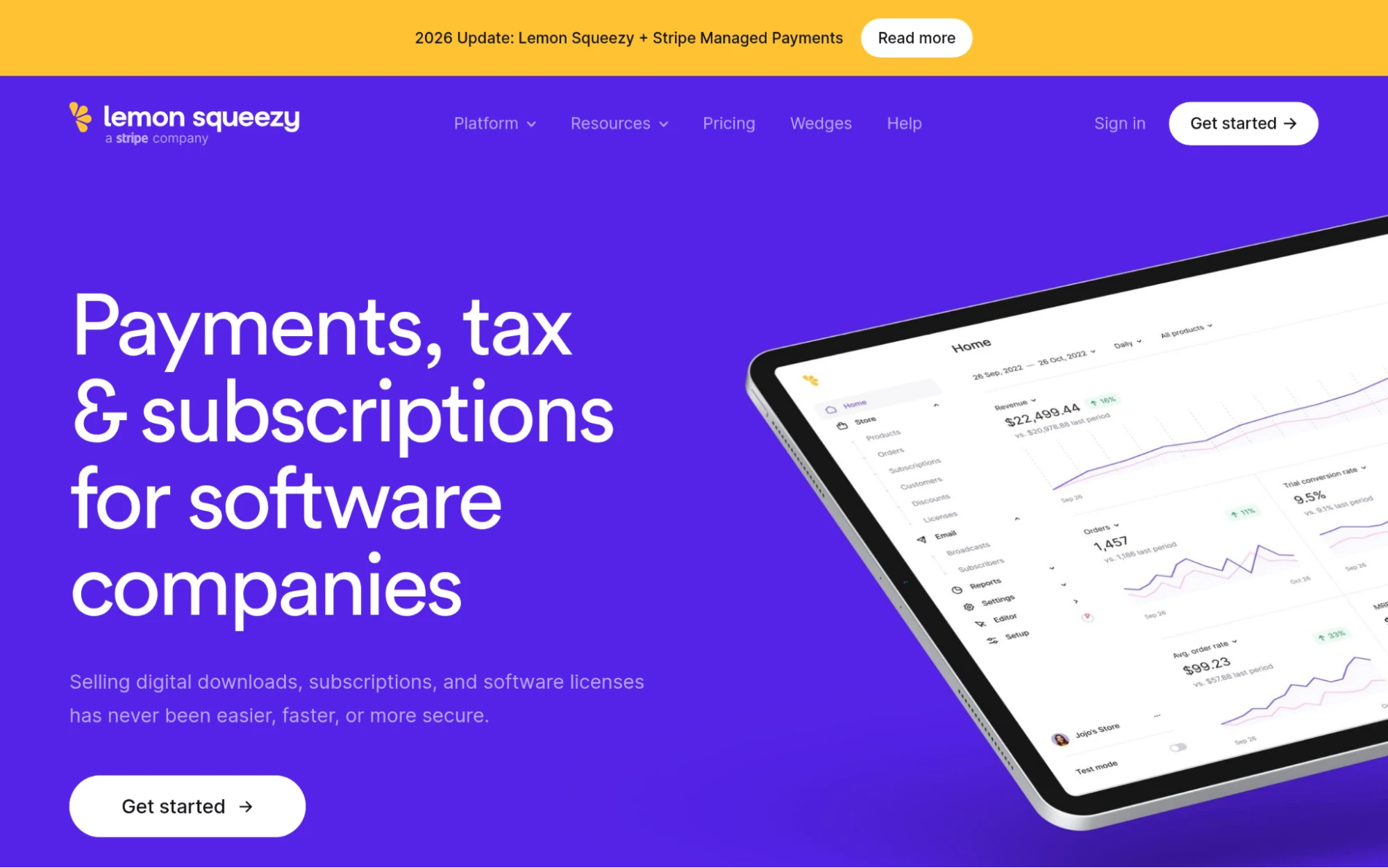
Lemon Squeezy combines payment processing, subscription management, tax compliance, and software-specific selling tools.
The platform supports more than 200 countries and 130+ currencies.
As the Merchant of Record, it handles areas such as:
- EU VAT collection
- Sales tax
- Subscription billing
- Fraud detection
- Payment recovery
- License key generation
Developers can also use its REST API and webhook support to connect the platform with existing software infrastructure.
Pricing is 5% + $0.50 per transaction.
Key Strengths
Lemon Squeezy was designed specifically around software and digital products.
Automatic license key generation is particularly useful for businesses selling downloadable software or other licensed products because payments, subscriptions, taxes, and product licensing can stay within one system.
Stripe’s acquisition of Lemon Squeezy in July 2024 also places the platform within a much larger payments ecosystem.
Evidence and Merchant Feedback
Lemon Squeezy reached $1 million in annual recurring revenue within nine months of its public launch.
The platform is now used by thousands of software companies and digital creators.
Available user feedback frequently points to tax handling and reduced checkout friction as important benefits.
What to Consider
Its feature set is particularly aligned with software distribution.
Companies with more complex enterprise billing structures or highly customized subscription requirements may want to compare that specialization with broader platforms built around larger SaaS operations.
3. Paddle – Best for Software and SaaS Subscription Billing
Platform Profile
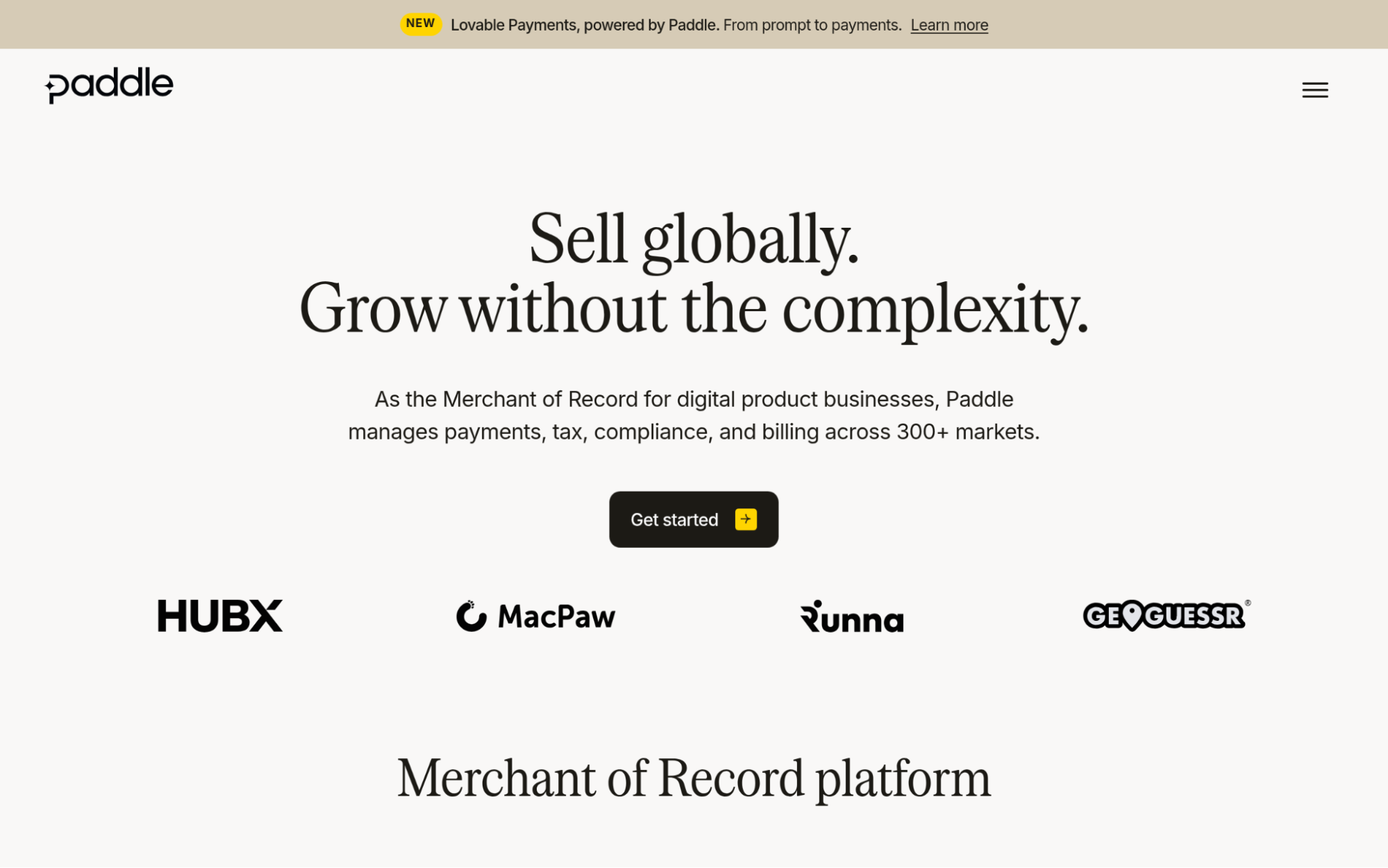
Paddle has operated since 2012 and provides Merchant of Record infrastructure for software and SaaS companies across more than 300 markets.
Its platform covers:
- Subscription billing
- Checkout
- Invoicing
- Fraud protection
- Tax remittance
- Revenue analytics
In 2024, Paddle processed more than $1 billion in payments and collected over $100 million in sales taxes for approximately 4,000 customers.
Key Strengths
Paddle’s biggest differentiator is its experience handling international SaaS billing at scale.
Tax requirements multiply quickly as a company enters new markets. Paddle centralizes those obligations rather than requiring finance teams to monitor and manage each jurisdiction independently.
The platform also extends beyond basic payment processing into subscription and revenue management.
Evidence and Merchant Feedback
Published customer examples include Renderforest, which reported 3X ARR growth, and MacPaw, which reported a 200% revenue increase.
Kaleido has also reported 20% month-over-month customer growth while using the platform.
Paddle has raised $293 million across seven funding rounds and reached a reported valuation of $1.4 billion.
What to Consider
Paddle’s position is stronger for companies that already have meaningful SaaS scale or expect more complex international operations.
Early-stage founders primarily looking for a lightweight, predictable transaction fee may prefer to compare its custom pricing model with simpler pay-as-you-go providers.
4. Polar – Best for AI Startups and SaaS Companies Needing Usage-Based Billing
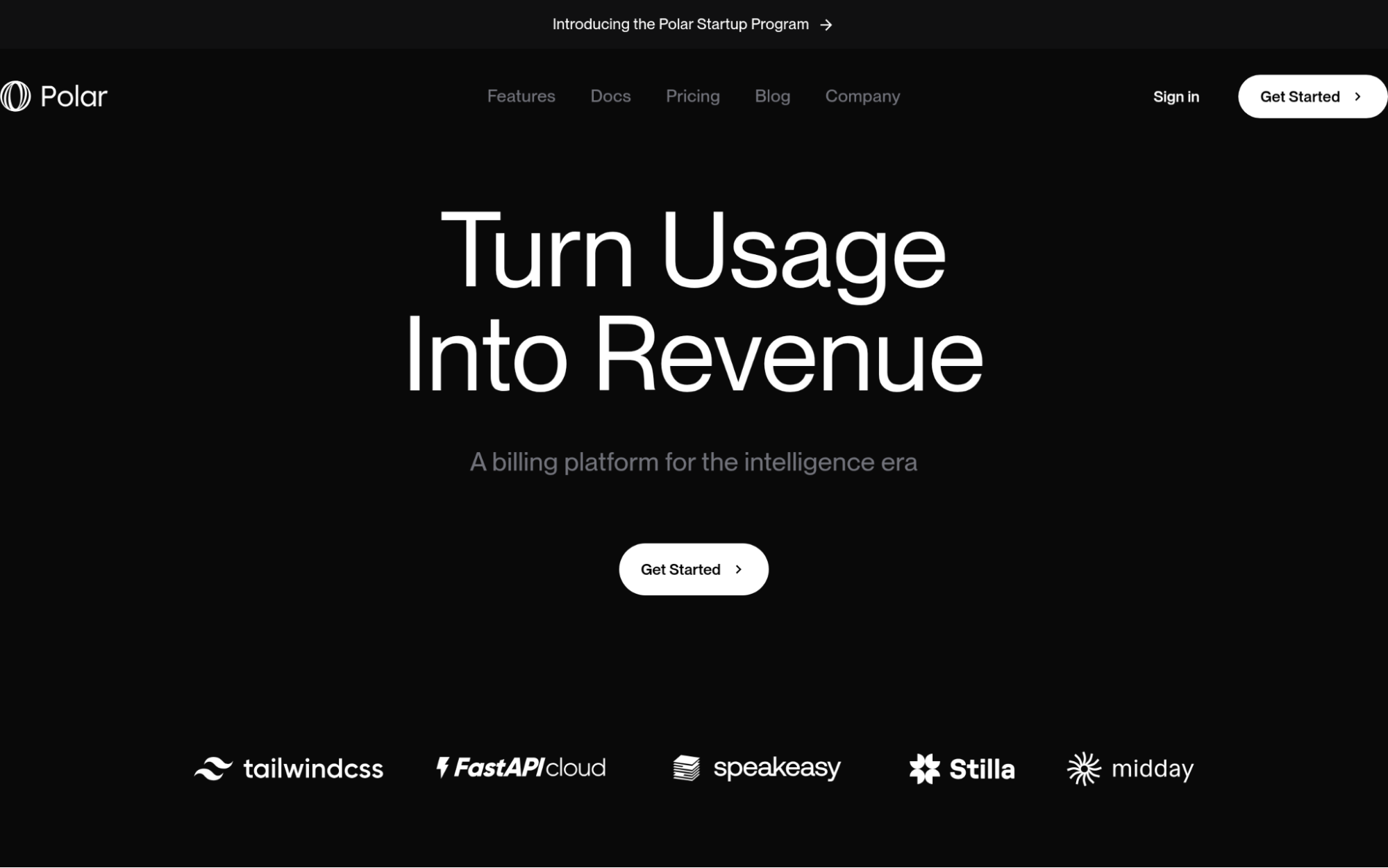
Platform Profile
Polar is designed around a different type of SaaS monetization.
Instead of focusing mainly on traditional flat monthly subscriptions, it supports flexible models such as:
- Usage-based billing
- Credits
- Seats
- Subscriptions
- Trials
- Discounts
Its event infrastructure can track usage in real time, allowing businesses to connect billing with metrics such as token or compute consumption.
As the Merchant of Record, Polar also handles VAT, sales tax compliance, receipts, and dunning.
Key Strengths
Polar’s strongest differentiator is the connection between billing and product usage.
AI companies often need to charge according to variable consumption rather than a fixed plan.
Traditional subscription systems were not necessarily designed around that model.
Polar allows usage events to feed directly into billing while also providing real-time visibility into unit economics.
The platform is also open source.
Evidence and Merchant Feedback
Polar is used by teams including Tailwind Labs and Midday.
People associated with developer communities such as Vercel and FastAPI have also publicly endorsed the platform.
The company raised a $10 million seed round led by Accel in June 2025.
Its open-source model has also helped establish credibility among technical founders that want greater transparency into their billing infrastructure.
What to Consider
Polar’s specialization is also its main limitation for some buyers.
Companies running straightforward software subscriptions may not need its event-level usage infrastructure.
Its value becomes more significant when the amount customers pay is directly connected to variable product consumption.
How the Four Merchant of Record Providers Differ
The platforms overlap in tax and payment responsibilities, but their strongest use cases are different.
| If Your Priority Is… | Provider to Consider |
| Fast global SaaS setup with straightforward pricing | Fungies.io |
| Selling licensed software or digital products | Lemon Squeezy |
| Mature global subscription infrastructure | Paddle |
| AI, token, compute, or usage-based billing | Polar |
This distinction matters because choosing a Merchant of Record only by comparing country counts or transaction fees can hide important differences in how each product is actually built.
Four Questions That Can Narrow the Choice Quickly
How Do You Charge Customers?
Start with your billing model.
If customers pay a traditional subscription, several platforms may work.
If billing depends on usage, tokens, compute, credits, or another variable metric, the shortlist becomes much narrower.
What Exactly Are You Selling?
Software licensing can create different requirements from a browser-based SaaS subscription.
Businesses selling licensed digital products may value Lemon Squeezy’s built-in license key functionality, while AI startups may care more about Polar’s event-based billing.
How Quickly Are You Expanding?
A founder entering the first few international markets may prioritize simple onboarding and predictable pricing.
A SaaS company already operating across dozens of markets may place more weight on established compliance infrastructure and operating history.
How Much Infrastructure Do You Want to Manage?
The main purpose of using a Merchant of Record is to remove operational complexity.
If the provider still requires several separate tax, billing, fraud, or payment tools, it may not be solving enough of the underlying problem.
Pricing Is Only Part of the Cost
Merchant of Record pricing should not be evaluated purely as a transaction percentage.
The fee may replace internal or third-party costs associated with:
- Tax registration and remittance
- Subscription infrastructure
- Fraud prevention
- Chargeback management
- Payment integrations
- Compliance maintenance
- Finance operations
A 5% transaction fee may appear expensive when viewed only as payment processing.
The comparison changes when that fee replaces several other systems and operational responsibilities.
At higher transaction volumes, however, percentage-based fees become increasingly important, which is why larger companies should model their expected GMV before committing.
Payment Performance Matters Too
Tax compliance is only one part of international selling.
A technically compliant checkout that international customers cannot successfully complete still creates a revenue problem.
When comparing providers, useful performance metrics include:
- Payment authorization rate
- Checkout conversion by market
- Failed payment rate
- Payment recovery rate
- Chargeback ratio
- Free-trial-to-paid conversion
Businesses should understand which of these metrics are available directly in the platform and which require additional reporting.
Research and Selection Process
The initial research covered a broader group of Merchant of Record platforms found through payment directories, SaaS review aggregators, product documentation, and published case studies.
Public Evidence
Official product pages were used to document features, supported markets, tax responsibilities, and billing capabilities.
Customer reviews and case studies were then used to determine whether those capabilities appeared in real merchant experiences.
Provider Filtering
Platforms were removed when their Merchant of Record responsibilities were unclear, meaningful public merchant evidence was unavailable, or recurring customer issues created unresolved concerns.
Consistency across sources mattered more than a high rating on a single review platform.
Claim Validation
Important product claims were compared with external evidence where available.
This included:
- International coverage
- Transaction volume
- Customer results
- Tax handling
- Merchant setup
- Billing flexibility
Where official claims and customer evidence differed, greater weight was given to demonstrated merchant outcomes.
Merchant of Record Requirements
The final shortlist focused specifically on providers that take on meaningful Merchant of Record responsibilities rather than simply providing a checkout or payment gateway.
That included responsibilities related to:
- Tax collection and remittance
- VAT and GST
- Subscription billing
- Payment processing
- Fraud management
- Chargeback handling
- International merchant compliance
Read More!
6 Best Two-Way SMS Software for Customer Support
10 Platforms for Visibility in AI-Driven Answers in 2026
Final Comparison
Fungies.io, Lemon Squeezy, Paddle, and Polar all help digital businesses reduce the complexity of selling internationally, but they are not interchangeable.
- Fungies.io is positioned around fast setup, broad SaaS coverage, and predictable transaction pricing.
- Lemon Squeezy is closely aligned with software and digital product businesses that also need licensing functionality.
- Paddle brings greater operating history and infrastructure scale for SaaS companies running more mature subscription businesses.
- Polar is differentiated by usage-based billing and real-time consumption tracking for AI and other variable-usage products.
The best choice comes down to the product being sold, how customers are charged, where the company is expanding, and how much billing and compliance complexity the team wants the Merchant of Record to absorb.