
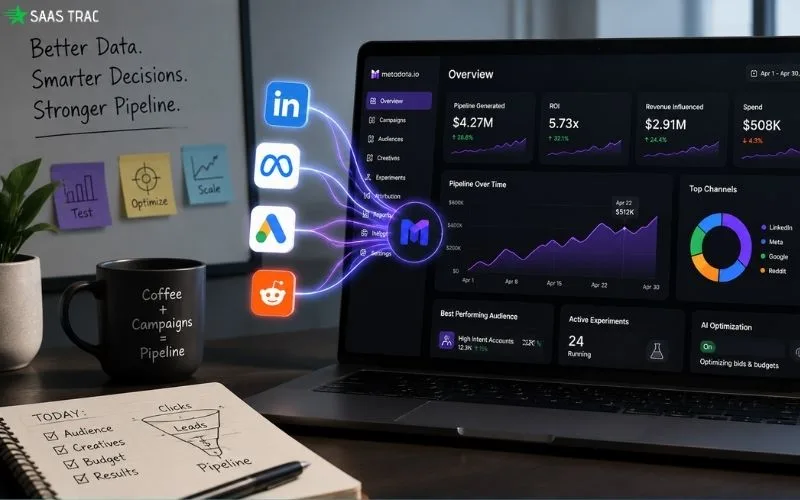
B2B paid advertising in 2026 is a brutal grind. Costs per lead are climbing, attribution is fragmenting, and demand gen teams are expected to deliver pipeline across LinkedIn, Meta, Google, and Reddit, often with the same headcount they had three years ago. Manually building audiences, launching experiments, optimizing bids, and tracking revenue across every channel is genuinely impossible without bringing in serious automation. That’s exactly the gap Metadata.io is built to close.
It’s an AI-native B2B paid marketing platform that automates audience building, multivariate testing, bid optimization, and revenue attribution all from one dashboard. Instead of hiring an agency or running endless manual experiments, demand gen teams point Metadata.io at their goals, and AI agents handle the execution 24/7.
In this detailed write-up, I’ll walk you through what the platform actually does, how its features perform in real-world use, what it costs, and whether it’s worth the investment in 2026. By the end, you’ll know whether Metadata.io fits your demand gen goals, or whether a different solution might suit you better.
What Is Metadata.io?
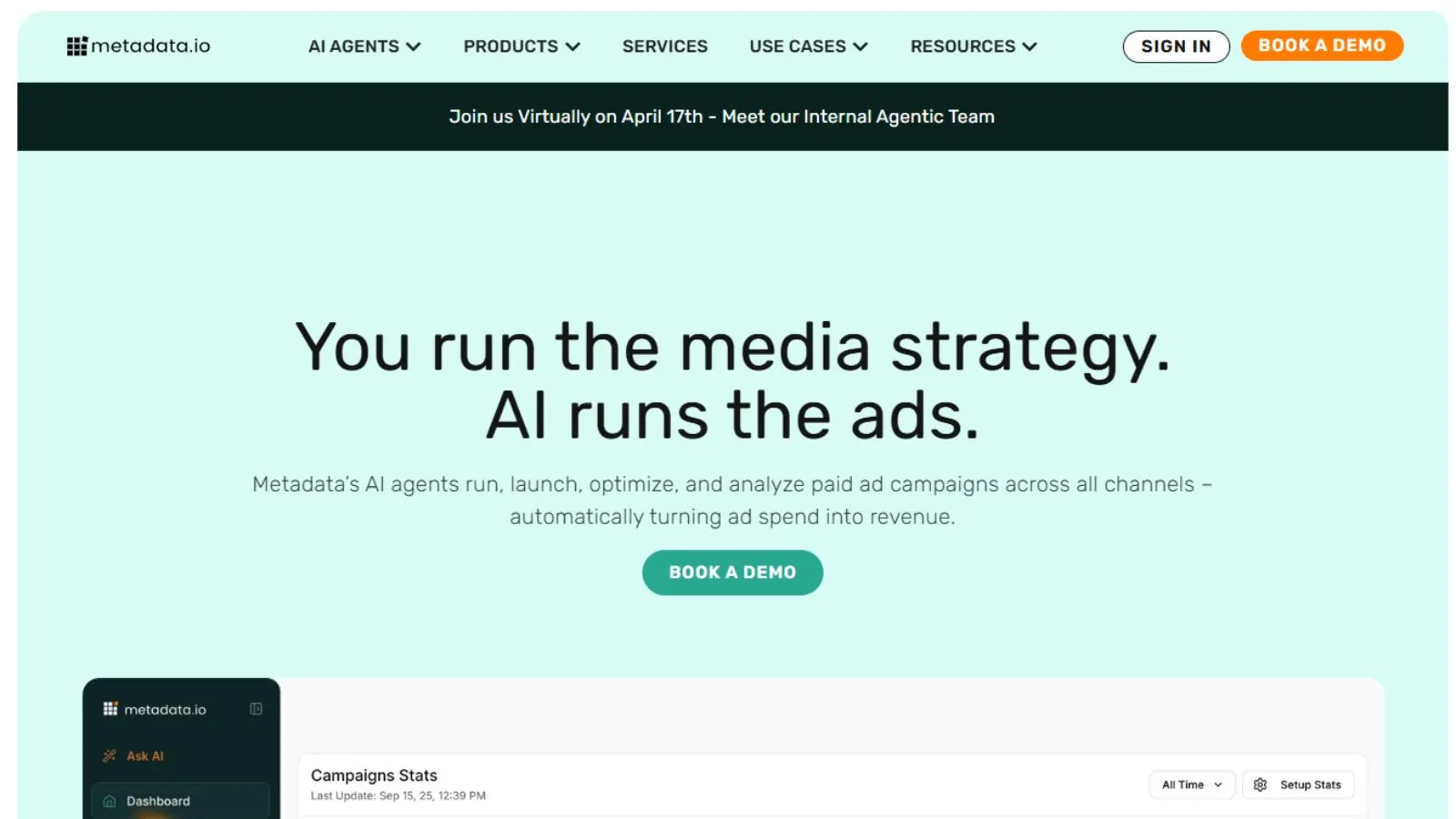
Metadata.io is an AI-native B2B digital advertising and marketing operations platform that automates paid campaign execution across LinkedIn, Meta, Google, Reddit, and other major channels. Instead of manually managing each ad platform separately, demand gen teams orchestrate everything from one place, with AI agents handling the bidding, testing, budgeting, and reporting.
Founded in 2015 by Gil Allouche, the company is headquartered in San Jose, California, and has raised over $58M in venture funding. The platform now powers hundreds of B2B marketing teams at brands like Zoom, Okta, ThoughtSpot, G2, Workato, Cisco, HPE, and Notion. Its patented MetaMatch identity graph covers 1.5 billion+ matched profiles, enabling email-based B2B targeting on consumer channels like Facebook and Instagram.
Best of all, you don’t need to be a data scientist to use it. If you have a clear ICP, decent content, and a real ad budget, Metadata.io can launch hundreds of experiments and start optimizing for the pipeline within days.
Key Features:
Here’s a breakdown of what you get when you sign up for the platform.
1. MetaMatch Identity Graph:
The flagship feature. MetaMatch is Metadata.io’s patented B2B identity graph covering 1.5 billion+ matched profiles, connecting personal and business identities across email, firmographic, and demographic data. It enables hyper-targeted B2B audience building even on consumer-first channels like Facebook, Instagram, and Reddit.
2. Multivariate Experimentation at Scale:
Instead of testing two ad variants at a time, Metadata.io runs thousands of multivariate experiments simultaneously, combining different creatives, audiences, offers, and channels. The AI quickly identifies winning combinations and reallocates budget in real time, accelerating the path to scale.
3. AI Agents for Autonomous Campaign Management:
The platform now ships with over a dozen specialized AI agents handling audience building, bid management, budget allocation, creative testing, and reporting. Combined under the new MetadataONE “prompts to pipeline” experience, these agents can be orchestrated from natural language prompts via Claude or ChatGPT integrations.
4. Cross-Channel Campaign Orchestration:
Run paid social and paid search from one interface. LinkedIn, Meta (Facebook + Instagram), Google Ads, and Reddit all sit inside the same workflow. Performance, budgets, and pacing are managed centrally; there is no more switching between five different ad managers every morning.
5. Revenue-Based Optimization:
Most native ad platforms optimize for clicks or surface-level leads. Metadata.io connects directly to Salesforce, HubSpot, Marketo, Pardot, and Eloqua to optimize against meetings, pipeline, and revenue. It’s the difference between “we got 500 clicks” and “we generated $400K in pipeline.”
6. Lead Enrichment:
Every lead captured through your campaigns is automatically enriched with firmographic, technographic, and contact-level data before flowing into your CRM. This dramatically improves lead quality and shortens the time-to-qualification for SDR teams downstream.
7. Web Personalization:
Through the Reactful acquisition, the platform now offers website personalization based on visitor identity. You can personalize headlines, CTAs, and offers in real time based on the company a visitor works at, turning anonymous traffic into revenue more efficiently.
8. Cross-Channel Reporting & Industry Insights:
Unified dashboards show performance across every channel, audience, creative, and offer. Industry b2b benchmarks help contextualize whether your CPL, conversion rate, and pipeline velocity are above or below peer norms, useful both for optimization and for executive reporting.
Metadata.io Pricing: How Much Does It Cost?
When it comes to metadata pricing, the platform sits firmly in the enterprise tier and isn’t published transparently on the website. Here’s what publicly available sources reveal:
- MetaMatch (entry module), starting around $295/month for basic identity graph access.
- Audience & Web Personalization Modules, Approximately $24,000/year per module.
- Core Platform, Around $60,000-$70,000/year for the full demand gen automation suite, often with a one-time setup fee.
- Custom Enterprise Tailored quotes based on modules selected, ad spend volume, and services required.
Most practitioners agree you need at least $20,000-$50,000/month in ad spend to generate enough experiment volume for the AI to deliver meaningful ROI. Below that threshold, the platform fee dilutes your unit economics. Compared to alternatives like 6sense, Demandbase, RollWorks, and Terminus, most of which sit in similar enterprise pricing tiers, Metadata.io is competitive when you’re spending serious money on paid acquisition.
A custom demo and tailored quote are available directly from the sales team.
👉 Check Live Metadata.io Plans & Current Deals
Pros of Using the Platform:
Here’s what genuinely makes this tool stand out in the crowded B2B martech space.
- MetaMatch identity graph is unmatched, 1.5B+ profiles with email-based targeting on Facebook is genuinely hard to replicate.
- AI agents are best-in-class. Over a dozen specialized agents automate the most tedious paid media tasks.
- Revenue-based optimization optimizes for pipeline and revenue, not just clicks or top-of-funnel leads.
- Multivariate testing at scale, run thousands of experiments simultaneously to find winning combinations fast.
- Strong CRM/MAP integrations, Salesforce, HubSpot, Marketo, Pardot, and Eloqua all work natively.
- Cross-channel from one dashboard, LinkedIn, Meta, Google, and Reddit, consolidated into one workflow.
- MetadataONE conversational AI, “Prompts to pipeline” experience powered by Claude/ChatGPT integrations.
- Strong customer roster: Zoom, Okta, Cisco, HPE, Notion, and Slack trust the platform.
- Web personalization included, Reactful acquisition adds real-time visitor personalization.
- Excellent support team, Reviewers consistently praise the white-glove customer success approach.
Cons to Keep in Mind:
No platform is perfect. Here are a few honest downsides to know before you commit to Metadata.io.
- High platform cost: At $60K+/year, it’s out of reach for early-stage startups and lean teams.
- Requires significant ad spend, Below $20K-$30K/month in ads, you can’t generate enough test volume for the AI to optimize meaningfully.
- Pricing isn’t transparent. It’s frustrating to evaluate without spending hours in sales conversations first.
- Steep learning curve, Advanced features like multivariate testing take time to master fully.
- Reporting can lag. Some users report Salesforce sync delays in the reporting dashboards.
- Initial price anchoring. Negotiations sometimes start at 3x the realistic landing point.
- Best for SaaS, Designed primarily for B2B SaaS. Other industries get less out of it.
What Makes It Stand Out From the Crowd?
The B2B paid media space is crowded, but a few things genuinely set the platform apart in 2026.
First, MetaMatch is genuinely unique. Most B2B targeting tools rely on LinkedIn’s first-party data or simple firmographic overlays. The patented identity graph maps real personal-to-business identity connections across 1.5 billion+ profiles, unlocking serious B2B targeting on cheaper consumer channels like Facebook, Instagram, and Reddit. For brands tired of LinkedIn’s escalating CPCs, this alone is reason enough to consider the platform.
Second, the AI agent architecture is genuinely ahead of competitors. While many platforms slapped a “ChatGPT wrapper” on existing features in 2024 and 2025, the team built more than a dozen specialized agents that actually own discrete pieces of the workflow. The new MetadataONE “prompts to pipeline” experience represents a real shift in how marketers can interact with the platform using natural language commands rather than complex dashboards.
Third, the focus on revenue rather than top-of-funnel metrics is rare. Most ad platforms reward you for clicks or leads, even if those leads never close. By syncing directly with your CRM and optimizing for closed-won revenue, this product aligns paid spend with the metrics your CFO actually cares about. For demand gen leaders fighting for budget, that alignment is genuinely game-changing.
Fourth, the customer roster is itself a meaningful signal. When brands like Zoom, Okta, Cisco, HPE, Notion, ThoughtSpot, Workato, and Slack all run their paid acquisition through the same platform, you know it can survive enterprise scrutiny, security reviews, compliance checks, integration depth, and ROI accountability. For mid-market and enterprise buyers in particular, this kind of social proof shortens the procurement cycle and helps make the internal business case much faster.
Who Should Use It?
The platform is a strong fit for:
- Mid-market and enterprise B2B SaaS companies are pending $30K+/month on paid acquisition.
- Demand gen teams running multi-channel campaigns across LinkedIn, Meta, Google, and Reddit.
- ABM-focused organizations that need precise targeting across LinkedIn and beyond.
- Marketing operations leaders seeking unified reporting and revenue attribution.
- Performance marketers running thousands of experiments who can’t keep up manually.
- Lean marketing teams want agency-level execution without hiring expensive consultants.
If you spend less than $20K/month on paid ads, this isn’t the right product for your stage. But if you’re scaling B2B paid acquisition seriously, Metadata.io can pay back its annual contract within a single quarter.
How to Get Started?
Getting up and running takes a few weeks for full implementation, but the initial setup is fast.
- Book a demo using this link.
- Connect your CRM, Salesforce, HubSpot, Marketo, or Pardot.
- Connect your ad accounts, LinkedIn, Meta Ads Manager, and Google Ads.
- Define your ICP using actual customer data inside Salesforce, not guesswork.
- Build your audiences, MetaMatch creates targeted segments across all paid channels.
- Launch experiments let the AI run multivariate tests across creatives, offers, and audiences.
- Monitor and optimize through the unified dashboard, focused on pipeline and revenue.
Our Final Verdict:
After extensive testing and reviewing thousands of verified user reviews on G2, Capterra, and TrustRadius, Metadata.io lands firmly on the positive side, but with critical caveats. It’s one of the most capable and most polished B2B paid media automation platforms in 2026. The combination of MetaMatch, AI agents, multivariate experimentation, and revenue-based optimization makes it genuinely hard to beat for serious demand gen teams.
Yes, the price tag is steep, and the minimum ad spend threshold puts it out of reach for early-stage startups. But for mid-market and enterprise SaaS teams already spending $30K+/month on paid acquisition, it’s one of the few platforms where the ROI math genuinely works. Reviewers consistently report 2-4x improvements in lead quality and meaningful drops in CPL within months.
If you’re spending real money on paid ads and are tired of doing it manually, book a demo to see whether the numbers work for your stage.
👉 Start Your Metadata.io Evaluation Today
Conclusion
B2B paid acquisition isn’t getting easier in 2026, but the right automation platform can transform how efficiently your demand gen team operates. If you want AI-powered audience targeting, revenue-based optimization, multivariate experimentation, and unified cross-channel reporting in one tool, Metadata.io is one of the smartest investments mid-market and enterprise B2B teams can make this year. The MetaMatch identity graph, AI agent automation, and Salesforce-connected revenue attribution alone make it a near-complete package for serious demand gen leaders. Click below to book your demo and see the numbers in action.
FAQs:
Q1. Is Metadata.io free?
Ans: No. The platform starts at roughly $60K/year for the core product, with custom enterprise pricing.
Q2. What ad platforms does it support?
Ans: LinkedIn, Meta (Facebook + Instagram), Google Ads, and Reddit, all from one dashboard.
Q3. What’s MetaMatch?
Ans: A patented B2B identity graph covering 1.5 billion+ matched profiles for email-based audience targeting.
Q4. How does it integrate with my CRM?
Ans: Native integrations with Salesforce, HubSpot, Marketo, Pardot, and Eloqua.
Q5. Who’s the ideal customer?
Ans: B2B SaaS companies spending $20K-$50K+/month on paid acquisition with a clear ideal customer profile.