

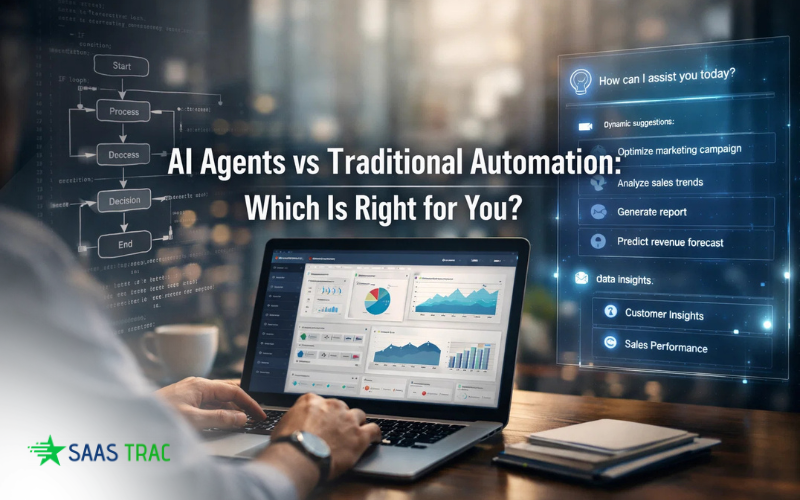
Automation has quietly powered businesses for decades. From automated email campaigns to invoice processing systems, rule-based tools have helped teams save time and reduce manual work. But as businesses become more data-driven and customer expectations evolve, a new type of automation is emerging: AI agents.
Unlike traditional automation systems that simply follow predefined rules, AI agents can analyze information, make decisions, and adapt to changing situations. This shift is transforming how companies approach productivity, operations, and customer experiences.
So the big question becomes: when comparing AI agents vs traditional automation, which approach is actually better for your business?
The answer isn’t as simple as choosing one over the other. Each serves a different purpose, and understanding those differences can help organizations design smarter workflows and future-proof their operations.
Let’s break it down – AI agents vs traditional automation:-
What Is Traditional Automation?
Traditional automation refers to systems that execute tasks based on predefined rules and workflows. These systems are designed around simple logic:
If X happens → then perform Y action.
For example, a marketing platform may automatically send a welcome email when someone signs up for a newsletter. A finance tool may generate reports every Friday. These tasks follow structured instructions and don’t require judgment or decision-making.
Over the years, traditional automation has been used across departments for processes such as:
- Data entry and data transfers
- Invoice processing and financial reporting
- Email scheduling and marketing campaigns
- HR onboarding checklists
- Compliance reporting
The main advantage of traditional automation is its predictability. Once configured correctly, it performs repetitive tasks quickly and consistently without human involvement.
Strengths of Traditional Automation
Traditional automation works well because it offers several practical benefits:
- Speed and efficiency
Automated workflows can process tasks much faster than manual work. - Lower operational costs
By reducing repetitive labor, companies can operate with smaller teams. - Accuracy and consistency
Machines perform tasks the same way every time, reducing human errors. - Ease of implementation
Many automation tools require minimal setup and can be deployed quickly.
However, despite these strengths, traditional automation has an important limitation: it cannot handle uncertainty.
Limitations of Traditional Automation
Rule-based automation breaks down when something unexpected happens.
For example:
- A customer message that doesn’t match predefined responses
- Missing or incomplete data in a workflow
- A process that changes frequently
- Complex decisions that require interpretation
When these situations occur, traditional systems usually fail or send the task back to a human.
That’s where AI agents come in.
What Is an AI Agent?
An AI agent is an intelligent software system designed to perform tasks autonomously by analyzing data, understanding context, and making decisions.
Unlike traditional automation tools that follow strict rules, AI agents operate with goals. They interpret information, choose actions, and improve their performance through learning.
This makes them far more adaptable in complex environments.
AI agents are built using technologies such as:
- Machine learning
- Natural language processing
- Large language models
- Predictive analytics
- Intelligent decision systems
Instead of simply executing instructions, AI agents behave more like digital workers that can interact with users, evaluate situations, and adjust their behavior over time.
For example, an AI support agent can:
- Understand customer queries
- Search internal documentation
- Generate responses
- Escalate issues when necessary
- Learn from past interactions
This ability to learn and adapt is what separates AI agent vs traditional automation.
AI Agents vs Traditional Automation: Key Differences

Understanding the distinction between the two becomes easier when comparing their core capabilities.
-
Decision-Making
Traditional automation executes predefined steps.
AI agents evaluate different options and decide the best course of action.
-
Learning Ability
Rule-based systems do not learn from past outcomes.
AI agents improve over time by analyzing data and feedback.
-
Flexibility
Traditional automation works best in stable environments.
AI agents can operate in dynamic environments where conditions frequently change.
-
Handling Unstructured Data
Automation systems require structured data, such as forms or databases.
AI agents can interpret unstructured data like text, images, or conversations.
-
Maintenance
Traditional automation requires constant rule updates as processes evolve.
AI agents require training and monitoring, but adapt more naturally.
These differences are why the debate around AI agents vs traditional automation is becoming more relevant for businesses today.
| Feature | AI Agents | Traditional Automation |
| Decision Making | Can analyze situations and make decisions | Follows predefined rules only |
| Learning Ability | Learns from data and improves over time | Does not learn or adapt |
| Flexibility | Handles dynamic workflows and changing inputs | Works best with fixed processes |
| Data Handling | Can process unstructured data like text and conversations | Requires structured data |
| Setup Complexity | Higher initial setup and training | Easier to set up |
| Maintenance | Improves with data but requires monitoring | Needs manual rule updates |
| Best Use Cases | Marketing strategy, SEO optimization, HR screening | Payroll, reporting, simple workflows |
Real Business Use Cases
To truly understand the impact of AI agents, it helps to look at real-world applications across different industries.
Marketing
Marketing teams often deal with dynamic data, changing customer behavior, and creative decision-making. This is exactly where AI agents outperform traditional automation.
Instead of simply scheduling posts or triggering email campaigns, AI agents can analyze audience behavior, generate messaging ideas, and optimize campaigns in real time.
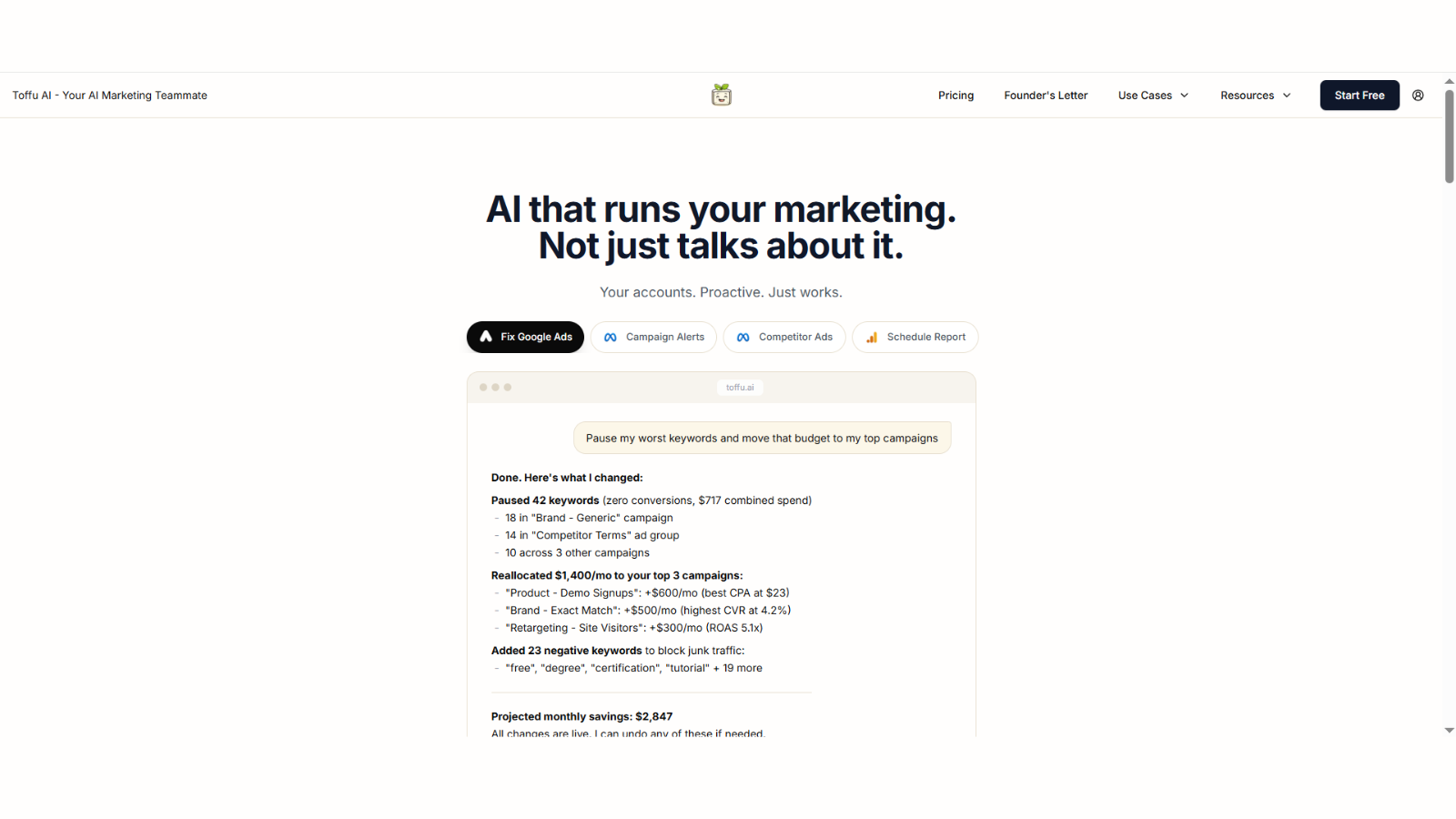
For example, tools like Toffu AI use intelligent AI systems to help marketers create data-driven campaigns, automate research, and refine messaging strategies.
👉 Read the full Toffu AI review:
https://aiagents.saastrac.com/ai-agent/toffu-ai/
👉 Try Toffu AI:
https://toffu.ai/?via=sumit
Similarly, platforms like Atria are designed to automate complex marketing workflows. These AI agents analyze campaign data, identify patterns, and help marketers make smarter decisions faster.
👉 Read the Atria review:
https://aiagents.saastrac.com/ai-agent/atria/
👉 Try Atria:
https://affiliates.tryatria.com/1mksc1z9lrz9
These examples show how AI agents vs traditional automation plays out in marketing. While traditional tools automate tasks, AI agents actively assist with strategy.
Human Resources
Human resources is another domain where intelligent automation is rapidly replacing rigid workflows.
Traditional automation in HR might send interview reminders or update employee records. But modern AI agents can screen resumes, personalize job applications, and even assist candidates throughout the hiring process.
One example is AIApply, a platform designed to automate and optimize job applications using AI.
Instead of manually filling out applications, users can rely on AI agents to generate tailored resumes, cover letters, and application responses.
👉 Read the AIApply review:
https://aiagents.saastrac.com/ai-agent/aiapply/
👉 Try AIApply:
https://www.aiapply.co/?via=sumit-ghosh
This is a great example of AI agent vs traditional workflow automation. Traditional systems move data around, but AI agents actually assist with decision-making and personalization.
Finance and Global Payments
Finance is an industry where accuracy and efficiency matter the most.
Traditional automation has long been used for tasks like invoice processing, payroll calculations, and financial reporting. These rule-based systems are fast but often struggle when unexpected situations arise.
AI agents introduce a new level of intelligence by analyzing financial patterns, predicting risks, and automating complex financial workflows.
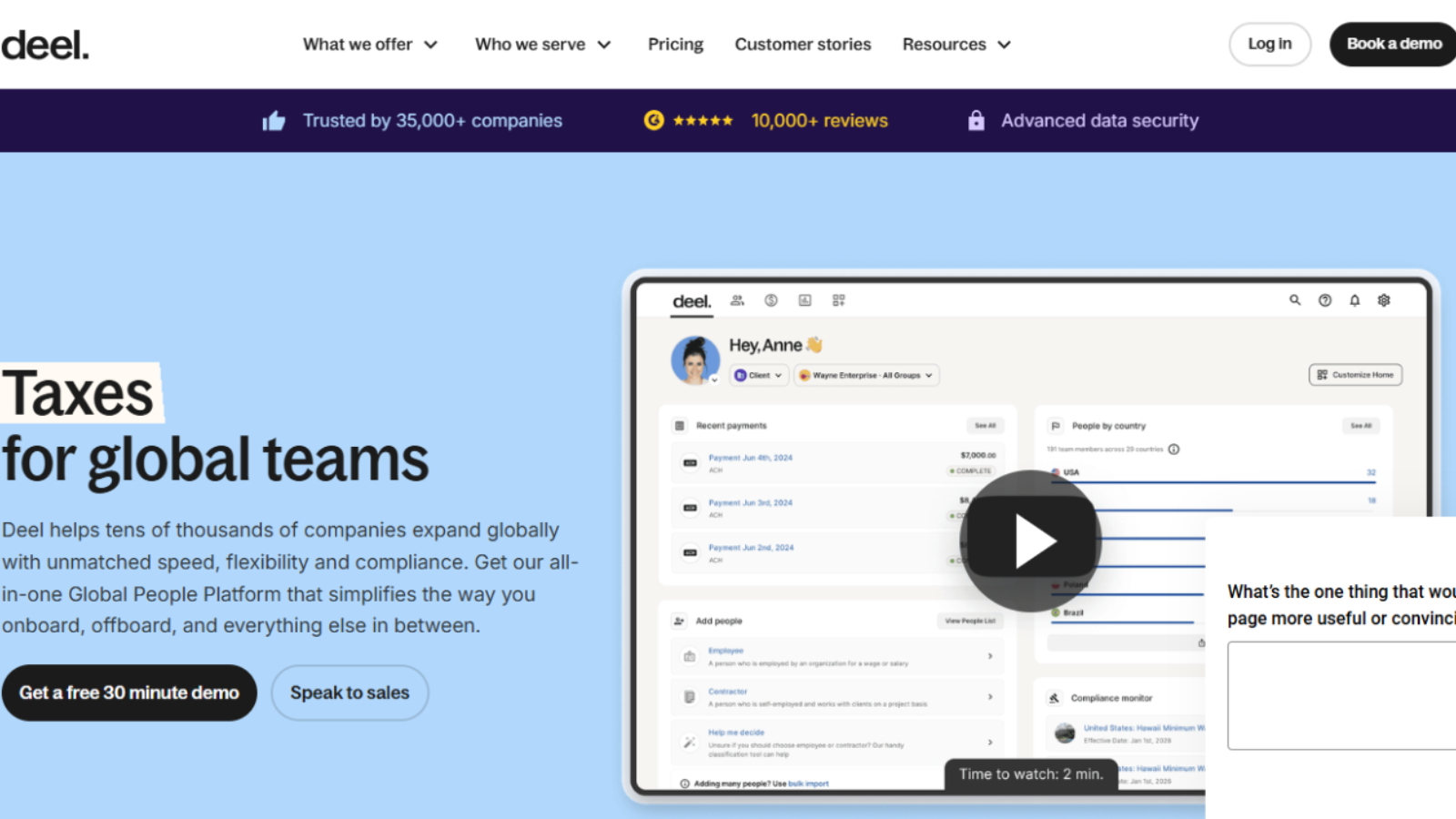
For instance, Deel AI helps companies manage global hiring, payroll, and compliance through AI-driven automation.
👉 Read the Deel AI review:
https://aiagents.saastrac.com/ai-agent/deel/
👉 Explore Deel AI:
https://aiagents.saastrac.com/ai-agent/deel/
Another powerful platform is AirWallex, which simplifies global payments and financial infrastructure using advanced technology.
👉 Try AirWallex:
https://partners.airwallex.com/jvhdo0t1a5oj
These platforms demonstrate how AI agents vs traditional automation can significantly impact operational efficiency in financial workflows.
SEO and Content Operations
Search engine optimization is another field experiencing rapid transformation due to AI agents.
Traditional SEO automation tools typically perform repetitive tasks like keyword tracking, backlink monitoring, or scheduled reporting.
But AI agents go much further.
They can analyze search intent, generate optimized content strategies, and continuously adapt SEO campaigns based on performance data.
For example, Scalenut provides AI-powered tools that help businesses automate keyword research, content planning, and SEO optimization.
👉 Read the Scalenut review:
https://aiagents.saastrac.com/ai-agent/scalenut/
👉 Try Scalenut:
https://scalenut.com/?fpr=sumit33
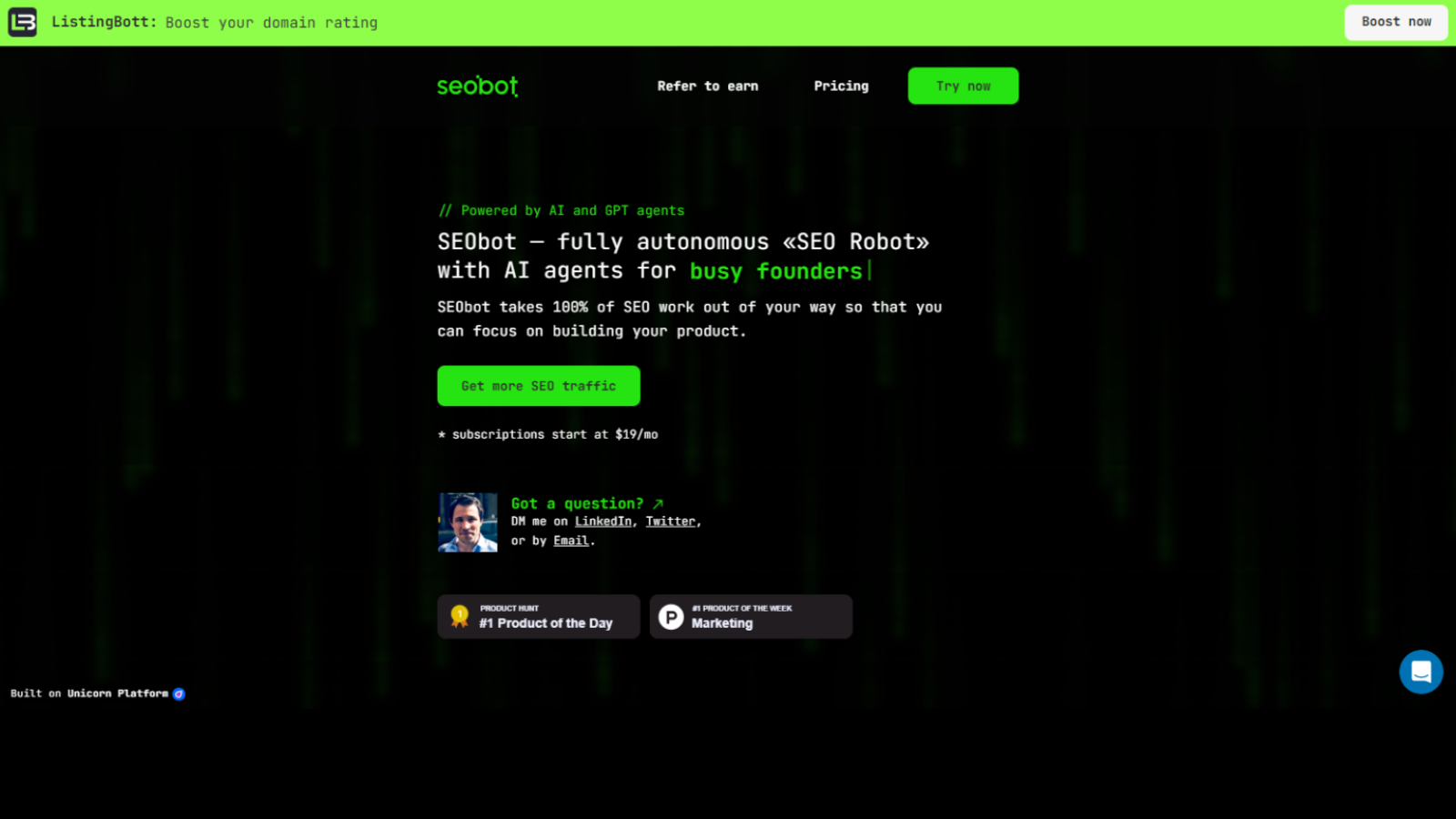
Another emerging AI SEO assistant is SEObot, which helps automate technical SEO improvements and optimization tasks
👉 Read the SEObot review:
https://aiagents.saastrac.com/ai-agent/seobot/
👉 Try SEObot:
https://seobotai.com/?ref=sumit
These platforms illustrate how the shift from traditional tools to intelligent agents is changing how businesses approach search visibility..
Cost Comparison: AI Agents vs Traditional Automation
Cost is often one of the biggest factors when businesses choose an automation strategy.
Traditional Automation Costs
Traditional automation generally has lower initial costs because:
- Tools are easier to deploy
- Systems require less data preparation
- Workflows are simple to configure
This makes it ideal for small projects or straightforward processes.
However, over time, costs can increase as businesses scale. Managing hundreds of rules and exceptions often requires ongoing maintenance.
AI Agent Costs
AI agents usually involve a higher upfront investment due to:
- Model development
- Data preparation
- System training
- Integration with business systems
But once implemented, they can scale efficiently and reduce the need for manual intervention.
This is why many organizations see higher long-term ROI with intelligent automation.
ROI Comparison
When evaluating AI agents vs traditional automation, businesses should consider not just cost but also value.
Traditional Automation ROI
Traditional automation provides quick benefits such as:
- Reduced manual work
- Faster processing
- Predictable cost savings
Companies often see results immediately after deployment.
AI Agent ROI
AI agents provide a different type of value.
Instead of simply saving time, they can improve outcomes by:
- Enhancing decision-making
- Personalizing customer interactions
- Identifying new opportunities
- Adapting to changing conditions
Over time, this leads to improved customer experiences, better operational efficiency, and scalable growth.
When Traditional Automation Is the Right Choice
Despite the excitement around AI agents, traditional automation still plays an important role.
It remains the best choice when processes are:
- Repetitive and predictable
- Structured and rule-based
- Compliance-driven
- Unlikely to change frequently
Examples include payroll processing, document routing, and scheduled reporting.
In these cases, adding AI may not provide additional value.
When AI Agents Make More Sense
AI agents become valuable when processes involve complexity, uncertainty, or decision-making.
Businesses should consider AI agents when:
- Customer interactions are unpredictable
- Workflows require interpretation
- The data is incomplete or unstructured
- Scaling operations increases complexity
For example, customer support, marketing personalization, and demand forecasting often benefit significantly from AI-driven systems.
This is why many companies are adopting hybrid automation strategies.
The Rise of Hybrid Automation
Rather than choosing AI agents vs traditional automation, many organizations are combining them.
In a hybrid workflow:
- Traditional automation handles structured triggers.
- AI agents analyze data and make decisions.
- Automation executes final actions.
For example:
- A lead form submission triggers automation.
- An AI agent analyzes the lead’s profile.
- The system generates personalized outreach.
This combination allows businesses to benefit from both efficiency and intelligence.
How Businesses Should Choose the Right Approach
Choosing between AI agents and traditional automation doesn’t need to be complicated.
Start by asking a few key questions:
- Does the process change frequently?
- Does it require judgment or interpretation?
- Are exceptions common?
- Will scaling increase complexity?
If the answer to most questions is no, traditional automation is likely sufficient.
If the answer is yes, AI agents may offer better long-term value.
The goal is not to adopt new technology for its own sake but to solve real operational challenges.
Final Thoughts
The discussion around AI agents vs traditional automation is less about replacing one technology with another and more about understanding where each fits.
Traditional automation remains extremely valuable for stable, rule-based workflows that require speed and consistency.
AI agents, on the other hand, unlock new possibilities by enabling systems to learn, adapt, and make decisions in dynamic environments.
For most businesses, the future lies in combining both approaches. Automation can handle predictable tasks, while AI agents tackle complex decisions and evolving challenges.
By using the right technology in the right place, organizations can create smarter systems, improve productivity, and build operations that scale with the future.
FAQS – AI Agents VS Traditional Automation
- What is the main difference between AI agents vs traditional automation?
Traditional automation follows fixed rules, while AI agents can analyze context, make decisions, and complete multi-step tasks autonomously. - Can AI agents replace traditional automation tools?
Not entirely. Most businesses use a hybrid approach where traditional automation handles repetitive workflows and AI agents manage complex, decision-based tasks. - Are AI agents expensive to implement for businesses?
Many AI agent tools are surprisingly affordable and can reduce operational costs by automating research, content creation, and workflow management. - Which industries benefit the most from AI agents?
Marketing, HR, finance, and SEO are currently seeing the biggest impact from AI agents due to data-heavy workflows.