

Running a business in India in 2026 means accepting payments across credit cards, debit cards, UPI, net banking, EMI options, BNPL, digital wallets, and international cards, often all at the same time. Setting that up with a traditional banking setup is a painful process: weeks of paperwork, opaque pricing, multiple integration steps, and zero developer-friendly tooling. Most founders end up either burning time on integrations or leaking revenue to payment failures and bad checkout UX.
That’s exactly the gap Razorpay is built to close. It’s India’s leading payment gateway software, trusted by more than 5 million businesses nationwide. From bootstrapped solopreneurs to fast-growing SaaS startups and large enterprises, Razorpay powers seamless, secure, multi-method payment acceptance with a clean dashboard, robust APIs, and an entire financial operating system built around it.
In this detailed write-up, I’ll walk you through what the platform actually does, how its features perform in real-world use, what it costs, and whether it’s worth your business in 2026. By the end, you’ll know whether it fits your payment goals or whether another gateway might suit you better.
What Is Razorpay?

Razorpay is India’s largest full-stack payments and financial infrastructure platform, founded in 2014 by Harshil Mathur and Shashank Kumar. Instead of stitching together a payment gateway, a current account, a payouts tool, and a billing system, you get everything under one roof, with the deepest local payment method coverage available in India.
The platform powers more than 5 million Indian businesses and processes billions of dollars in payments every year. It holds an RBI-authorized Payment Aggregator license, supports every major Indian payment method (UPI, credit/debit cards, net banking, EMI, wallets, BNPL, international cards), and offers a sprawling ecosystem including RazorpayX (banking), Razorpay Capital (lending), Razorpay Payroll, and Magic Checkout for one-click conversions. The Razorpay payment gateway is consistently rated as the best in India by developers, founders, and finance teams alike.
Best of all, you don’t need a 10-person finance team to get started. A single founder can sign up online and start accepting payments within hours of approval.
Key Features:
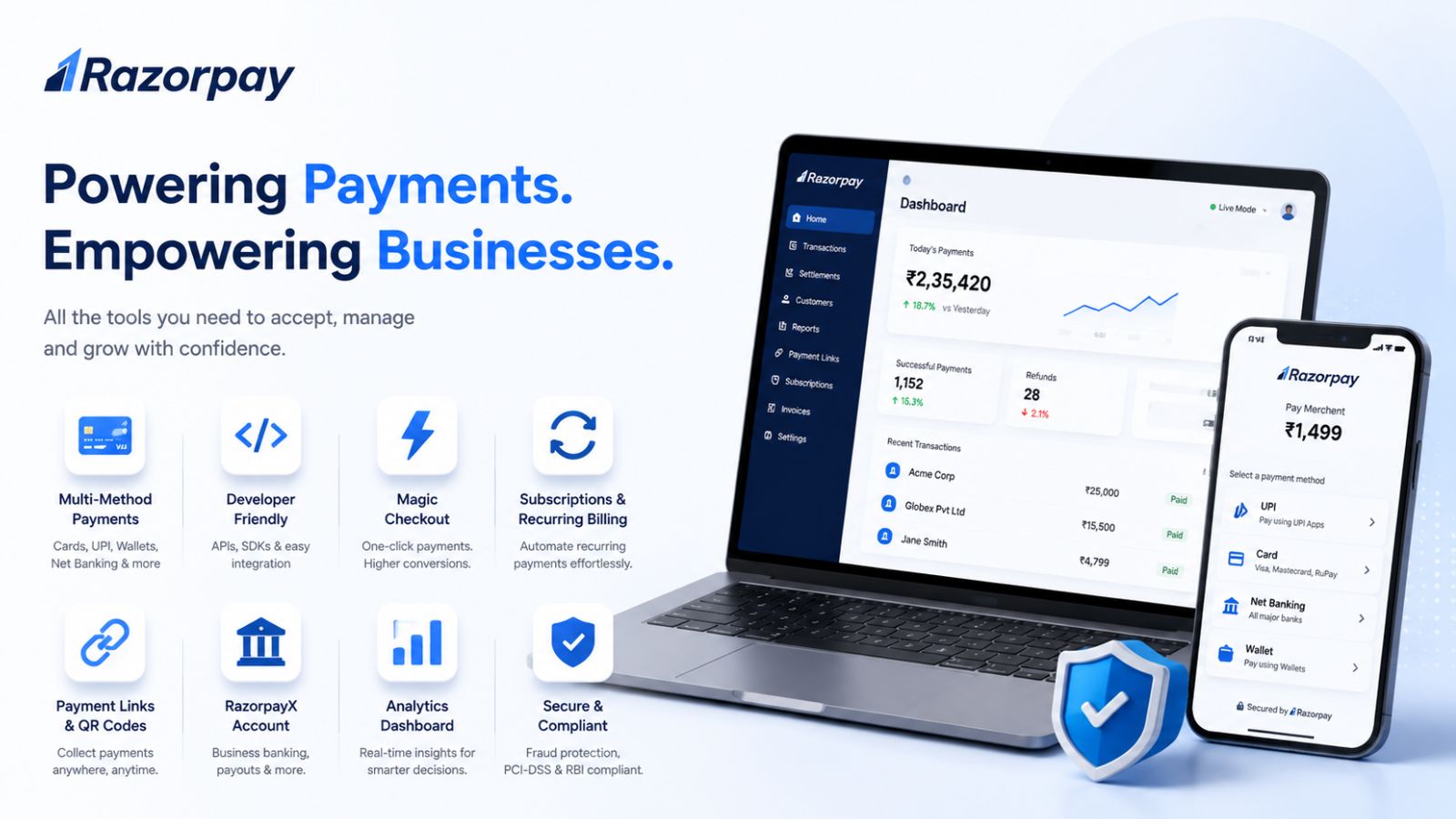
Here’s a breakdown of what you get when you sign up for the platform.
1. Multi-Method Payment Acceptance:
The flagship feature. Accept payments via credit and debit cards (Visa, Mastercard, RuPay, Amex), UPI, net banking, EMI options, BNPL (Buy Now Pay Later), wallets (Paytm, PhonePe, Mobikwik), and international cards, all through a single API integration. Coverage is the deepest in India.
2. Developer-Friendly APIs & SDKs:
REST APIs with SDKs for Node.js, Python, PHP, Ruby, Java, .NET, iOS, and Android make integration straightforward. Pre-built checkout widgets, payment buttons, and payment pages let non-developers accept payments in minutes without ever touching code.
3. Magic Checkout (One-Click):
A fully optimized checkout flow that auto-fills address, contact, and payment details for returning shoppers. Magic Checkout reportedly lifts conversion rates by 30-40% versus standard checkout, mand easurable revenue gains for e-commerce stores struggling with cart abandonment.
4. Subscriptions & Recurring Billing:
Built-in subscription billing with support for trials, plan upgrades, prorated charges, dunning logic, and automated retries on failed payments. SaaS founders can launch a full recurring billing engine without integrating Stripe Billing or building it manually from scratch.
5. Payment Links & QR Codes:
Generate shareable payment links via WhatsApp, SMS, or email, perfect for freelancers, service businesses, and offline merchants who don’t run a website. Custom QR codes work great for retail stores, food trucks, and field sales teams.
6. RazorpayX & Current Account
The platform’s banking arm offers a current account, payouts to vendors and employees, automated invoicing, vendor payments, and bulk payouts via UPI/IMPS/NEFT. For businesses processing significant volume, keeping collections and payouts inside one ecosystem dramatically simplifies reconciliation.
7. Detailed Dashboard & Analytics:
The web dashboard is genuinely best-in-class for Indian payment gateways. Refund management, dispute handling, transaction analytics, payment method breakdown, and settlement reports are all clean, intuitive, and ahead of competitors like PayU and CCAvenue.
8. Fraud Protection & Compliance:
Built-in fraud detection, PCI-DSS Level 1 compliance, 3D Secure 2.0 authentication, and ML-based risk scoring keep your business protected. As an RBI-authorized Payment Aggregator, the company also handles GST invoicing, TDS, and compliance reporting automatically.
Razorpay Pricing: How Much Does It Cost?
When it comes to fees, the structure is refreshingly transparent compared to traditional Indian banks. Here’s a quick snapshot:
- Standard Domestic Transactions, 2% per transaction + 18% GST on the fee. Covers cards, UPI (business), net banking, and wallets.
- International / Premium Card Transactions 3% per transaction + 18% GST. Includes Amex and international cards.
- Setup Fees: Zero. No onboarding charges, no annual maintenance fees, no minimum processing requirements.
- Custom Pricing Once your monthly GMV crosses ₹5 lakh, custom rates of 1.4-1.6% are realistically negotiable for established businesses.
Settlement is T+2 for most accounts, and T+1 is available on paid plans. RazorpayX, Capital, Payroll, and Magic Checkout each have their own usage-based pricing structures. Compared to alternatives like PayU, CCAvenue, Cashfree, and Instamojo, the platform sits firmly in the premium tier, but its reliability, success rate, and developer experience genuinely justify the spend for serious online businesses.
A completely free standard account makes it easy to test integrations risk-free before committing to volume.
👉 Check Live Razorpay Plans & Current Deals
Pros of Using the Platform
Here’s what genuinely makes this tool stand out in the crowded Indian payment gateway space.
- Deepest payment method coverage in India, UPI, cards, net banking, EMI, BNPL, wallets, international, all in one API.
- Best-in-class dashboard, reporting, refund handling, and dispute management ahead of PayU and CCAvenue.
- Strong developer experience, Clean APIs, SDKs in every major language, and world-class documentation.The The
- Payment Aggregator license is RBI-authorized, regulated, and trusted by enterprise procurement teams.
- Magic Checkout boosts conversions. One-click checkout lifts conversion rates by 30-40% on average.
- Zero setup or annual fees, pay only when you process. No hidden recurring costs eat into margins.
- 5 million+ businesses trust it, Battle-tested at scale across every Indian industry vertical.
- Subscriptions and recurring billing included SaaS-ready billing without separate platform fees.
- Connected financial ecosystem, Banking, Capital, and Payroll consolidate your money operations.
- Responsive support Relationship managers for higher-volume accounts; chat and email for all.
Cons to Keep in Mind:
No platform is perfect. Here are a few honest downsides to know before you commit.
- Higher rates than budget gateways, Newer competitors quote 1.75-1.85%, while standard rates here are 2%.
- 18% GST on top of fees, the Indian tax structure adds meaningful overhead on every transaction.
- Document verification can take time, KYC and approval may take 3-7 business days for new accounts.
- International payment capabilities lag. Not ideal as the primary processor for cross-border revenue.
- Enterprise pricing is opaque. Custom rates require sales conversations rather than transparent quotes.
- Mobile app store policy limits, iOS/Android in-app purchases face platform-level restrictions.
- Settlement could be faster, T+2 default, while a few competitors offer faster T+0 or T+1 cycles standard.
What Makes It Stand Out From the Crowd?
The Indian payment gateway space is crowded, but a few things genuinely set Razorpay apart in 2026.
First, the breadth of payment methods is unmatched. While competitors typically offer cards plus UPI, the platform covers literally every Indian payment method that matters: cards, UPI, net banking from 50+ banks, every major wallet, BNPL options, EMI from 15+ banks, and international cards. For businesses serving diverse customer segments, that single integration handles every scenario without bolt-on services.
Second, the developer experience is genuinely world-class. While platforms like PayU and CCAvenue still feel like legacy banking integrations, the team built its entire stack as a developer-first product. Clean REST APIs, comprehensive SDKs, predictable webhooks, and excellent documentation mean a competent engineer can integrate payments in a single afternoon, not three weeks.
Third, the connected financial operating system is rare. Most competitors stop at the payment gateway. The platform extends across RazorpayX banking, capital lending, payroll for salaries and PF, and Magic Checkout for conversion. For founders who want to reduce vendor sprawl and consolidate their finance stack, having one trusted partner across payments, banking, and lending is genuinely transformative for operational efficiency.
Fourth, the operational dashboard quality is meaningfully ahead of every Indian competitor. Refund management, dispute handling, payment method analytics, success rate breakdowns by bank, and settlement reports are all clean, intuitive, and built for finance teams that actually have to use them every single day. For ops leaders and CFOs, that polished interface translates into hours of saved work every week and far cleaner monthly reconciliation cycles.
Who Should Use It?
The platform is a strong fit for:
- D2C and ecommerce brands that need every Indian payment method and want to maximize checkout conversion.
- SaaS startups building recurring billing without integrating Stripe or rolling their own.
- Freelancers and consultants who need quick payment links shareable via WhatsApp or email.
- Offline retailers and service businesses are using QR codes and POS integrations for in-store payments.
- Mid-market and enterprise companies processing high volumes that benefit from custom rates.
- Marketplaces and platforms managing split payouts, vendor payments, and complex flows.
- Subscription businesses need dunning logic, retries, and automated billing workflows.
If your business operates entirely outside India and serves only international customers, Stripe or PayPal may suit you better. But for any business with Indian customers, this is one of the smartest infrastructure choices available.
How to Get Started?
Getting up and running takes a few days from signup to your first live transaction.
- Sign up for the free account using this link.
- Complete KYC verification, PAN, GST, bank details, and business registration documents.
- Wait for approval, typically 3-7 business days for verification.
- Generate API keys in the dashboard and connect your platform.
- Integrate via SDK or pre-built checkout, pick what fits your stack and tech experience.
- Test in sandbox mode to verify the entire payment flow before going live.
- Activate live mode and start accepting real payments. Monitor everything in the dashboard.
Our Final Verdict:
After extensive testing and reviewing thousands of verified user reviews on G2, Capterra, and SoftwareSuggest, Razorpay lands firmly on the positive side. It’s one of the most capable and most polished payment gateways you can use in India in 2026. The combination of deepest payment method coverage, world-class developer experience, RBI-authorized Payment Aggregator status, and a connected financial ecosystem makes it genuinely hard to beat for serious Indian businesses.
Yes, the 2% rate is higher than newer budget competitors, and the 18% GST overhead adds friction. But when you factor in payment success rates, dashboard quality, and the time saved by integrating once for every payment method, the total cost of ownership math favors this platform almost every time for revenue-focused businesses.
If you’re still unsure about which products to start with, just open the standard payment gateway account. It’s free, fast to set up, and you’ll see the value with your very first successful transaction.
👉 Start Your Free Razorpay Account Today
Conclusion:
Accepting payments in India isn’t getting any simpler in 2026, but the right payment infrastructure can transform your conversion rates, cash flow, and operational efficiency. If you want the deepest payment method coverage, world-class developer experience, a beautiful dashboard, and an entire financial ecosystem around your core gateway, Razorpay is one of the smartest investments Indian businesses can make this year. From freelancers to enterprise teams, the platform scales seamlessly across every stage of growth. Click below to create your free account and start accepting payments today.
Frequently Asked Questions (FAQ):
Q1. Is Razorpay free to use?
Ans: Yes. No setup or annual fees. You only pay 2% + GST per successful transaction.
Q2. Which methods does it support?
Ans: Credit/debit cards, UPI, net banking, wallets, EMI, BNPL, and international cards.
Q3. How long does KYC take?
Ans: Usually 3-7 business days, depending on document verification and business type.
Q4. When is money settled?
Ans: T+2 is standard, with T+1 available on paid plans for faster cash flow.
Q5. Is it secure?
Ans: Yes. PCI-DSS Level 1 compliant, 3D Secure 2.0 enabled, and RBI-authorized Payment Aggregator.