
Running multiple restaurant locations means your POS system is doing a lot more than taking orders. The best restaurant POS software has to juggle staff training across locations, sync with third-party delivery platforms without falling apart, and hold up during Friday night rushes when every second of lost service time costs real money. After comparing dozens of restaurant POS platforms using product documentation, user feedback, feature information, and industry resources, the differences consistently come down to reliability, connectivity, and ease of adoption. This guide breaks down the top picks that hold up in real multi-location environments.
How the picks were chosen
Each platform was assessed using publicly available information pulled from official websites, user reviews, feature breakdowns, and restaurant technology directories. Only options with a documented track record in restaurant operations made the cut. The goal was a shortlist that reflects real-world performance, not just marketing claims.
→ See the full research breakdown
- Orders.co – Best for Independent and multi-location restaurants seeking an all-in-one POS solution
- Toast – Best for restaurant management and point of sale systems
- Square – Best for restaurant payment processing and operations management
- Soft Touch – Best for restaurant POS and payment processing
- Focus – Best for restaurant and hospitality business management
Why Restaurant POS Software Is Worth the Investment
Picking the wrong POS system doesn’t just slow down service. It quietly drains money through longer table turn times, botched delivery integrations, and staff who take weeks to get up to speed because the interface wasn’t built for restaurant work.
Multi-location restaurants have it especially rough here, because everything compounds. One platform that can’t sync menu changes across sites creates inconsistent customer experiences. A system that drops offline during peak hours turns a busy Saturday into a disaster.
Purpose-built restaurant POS software addresses those problems directly, because it was designed with kitchens, servers, and order flow in mind from the start.
The right system shows up in measurable ways: faster average transaction processing times, higher system reliability percentages during peak loads, and real improvement in table turn times that add up to more covers per shift.
Restaurant POS Software Comparison Table
Note: All data in this table is sourced from review platforms and the official websites of the listed companies.
| Company Name | Headquartered In | Best For |
| Orders.co | Los Angeles, CA | Independent and multi-location restaurants seeking an all-in-one POS solution |
| Toast | Boston, Massachusetts | Restaurant management and point of sale systems |
| Square | San Francisco, California | Restaurant payment processing and operations management |
| Soft Touch | N/A | Restaurant POS and payment processing |
| Focus | Boerne, Texas | Restaurant and hospitality business management |
-
Orders.co – Best for Independent and multi-location restaurants seeking an all-in-one POS solution
Where Does Orders.co Operate and What Is Its Purpose?
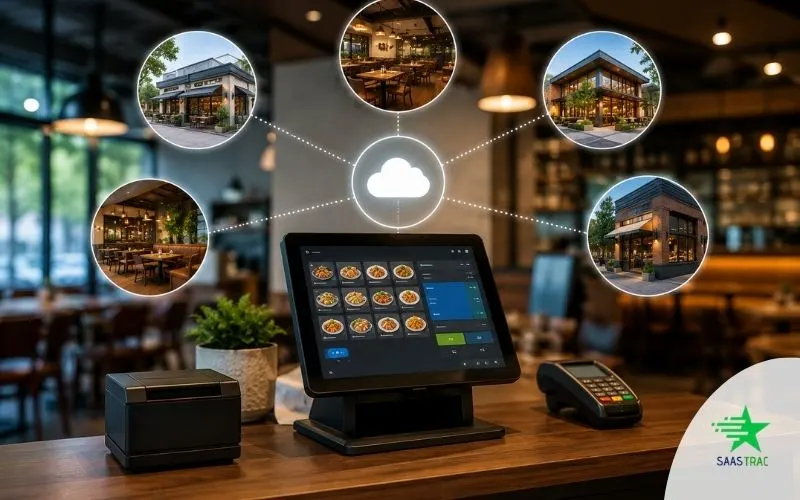
Orders.co is a cloud-based restaurant POS designed around a single premise: one screen for every order, regardless of where it came from. Dine-in tickets, phone orders, the restaurant’s own website, and marketplace volume from DoorDash, UberEats, Grubhub, and ezCater all land in the same place. Run that across eight sites and the value shifts from convenience to control, because the alternative is eight sets of menus, eight reporting silos, and a head office guessing at which location is actually performing. The platform includes:
- KDS and QR code dine-in ordering — kitchen routing and table-side ordering ship with the system rather than arriving as a separate purchase
- A catering module — its own ordering flows and dispatch, sized for catering volume rather than forced through the standard delivery path, ezCater orders included
- Order consolidation — every channel feeding one queue instead of a row of provider tablets
- Menu sync in real time — one edit reaches every connected channel, so a Tuesday price change doesn’t leave three stores ringing up last month’s numbers
- Reporting that holds up across sites — X and Z shift reports, top seller data, and provider-level performance, which is exactly where group-wide comparison tends to break down
- Delivery dispatch on flexible terms — each location routes deliveries the way its own operation runs
Alongside those, every account carries a commission-free ordering website, loyalty, automated marketing, and fast dispute management at no extra charge.
What’s Orders.co’s Edge in Restaurant POS Software?
Restaurants are not retail, and it shows the moment a repurposed retail system meets a nested modifier or a loyalty rule written for a checkout line instead of a dining room. Orders.co avoided that by starting in hospitality, so those mechanics hold from the first shift. What separates it in practice:
- Support is a phone call, 24 hours a day, seven days a week — a live person picks up, which is the whole point when one store drops mid-service and the others are still turning tables
- The commission-free ordering website is bundled, not upsold — direct orders stay direct, and that margin holds across the entire group rather than just the flagship
- Several subscriptions collapse into one — delivery tablets, menu management tools, and loyalty software all fold into the same platform, and every one of those line items would otherwise repeat at each new location
The Review Roundup:
The consolidated order view is what operators coming off a tablet stack mention first — it’s the change they feel on day one. Close behind is the automation, with loyalty and marketing campaigns running unattended instead of needing someone’s standing attention. The third recurring note is onboarding speed: staff who don’t think of themselves as technical get comfortable quickly, which carries real weight for a group deploying the same system across multiple sites, each with its own turnover to absorb.
-
Toast – Best for Restaurant Management and Point of Sale Systems
Where Does Toast Operate and What Is Its Purpose?
Toast is a Boston-based restaurant technology company founded in 2011 with a team of around 6,500 people. They build POS software exclusively for restaurants, covering everything from front-of-house ordering and payment processing to payroll, scheduling, and inventory management. Their system runs on Android hardware and connects to over 200 third-party tools. One feature worth calling out is Toast Router, which provides automated cellular backup so operations don’t go dark when the internet drops. That kind of reliability matters during peak service hours.
What’s Toast’s Edge in Restaurant POS Software?
Toast’s restaurant-only focus means the product doesn’t compromise on hospitality-specific features the way general business platforms sometimes do. Being used in roughly 120,000 US restaurants as of mid-2024 reflects the kind of widespread operator adoption that comes from a system actually holding up under real restaurant conditions.
The Review Roundup:
Toast users frequently call out the breadth of features and the reliability of the cellular backup as standout positives. The flip side that surfaces in reviews is the pricing structure, which can feel steep for smaller operations (think enterprise-level costs even at the single-location tier). Larger and multi-location restaurants tend to get the most value out of the platform’s full feature depth.
-
Square – Best for Restaurant Payment Processing and Operations Management
Where Does Square Operate and What Is Its Purpose?
Square is a San Francisco-based financial technology company founded in 2009 by Jack Dorsey, with a team of around 6,645 people. They pioneered mobile card reading and have since built a full business operating platform covering payments, inventory, e-commerce, payroll, and customer communications. For restaurants, Square offers a dedicated operating system that handles table management, menu customization, and order routing. Processing $241 billion in annual payments and serving 4 million sellers as of 2024, Square operates at a scale that few restaurant tech providers can match. Their $0 chargeback fee is a practical advantage for high-volume restaurant environments.
What’s Square’s Edge in Restaurant POS Software?
Square removes the friction between payment processing and broader operations management, which is where a lot of smaller restaurant operators lose time and money. Their tiered pricing model (including a free starting tier) means restaurants can get up and running without a major upfront commitment, which reduces the barrier to actually testing the system properly.
The Review Roundup:
Restaurants using Square consistently appreciate how quickly new staff can learn the system, which directly addresses the challenge of high turnover and training time. The platform’s flexibility across quick-service and full-service formats comes up often as a reason operators stick with it. The breadth of features available at the lower pricing tiers is what draws strong reviews from independent restaurant owners.
-
Soft Touch – Best for Restaurant POS and Payment Processing
Where Does Soft Touch Operate and What Is Its Purpose?
SoftTouch is a POS and payment processing provider with over 25 years of experience and more than 8,000 system deployments across restaurants and hospitality businesses. They serve a wide range of formats including quick-service restaurants, pizza delivery operations, bars, and upscale dining. Their platform covers customized POS systems alongside payment gateways that support multiple payment methods. What stands out about SoftTouch is the combination of long operational history and a dedicated client success team approach, which is more hands-on than what most software-first companies offer.
What’s Soft Touch’s Edge in Restaurant POS Software?
SoftTouch tackles a problem that newer platforms often underestimate: the need for genuinely tailored configuration across different restaurant formats, not just surface-level customization. Their 25-plus-year track record across 8,000 deployments signals a depth of real-world experience that shows up in how the platform handles edge cases in complex restaurant environments.
The Review Roundup:
Client feedback across CEO and business owner profiles points to SoftTouch’s service quality and competitive processing rates as consistent strengths. Endorsements from industry groups like the International Casual Furniture Association add a layer of third-party credibility that isn’t common in this space. Operators who value direct support relationships tend to rate SoftTouch very highly.
-
Focus – Best for Restaurant and Hospitality Business Management
Where Does Focus Operate and What Is Its Purpose?
Focus POS is a Boerne, Texas-based restaurant technology company that has been building POS software since 1990. With a small team of around 10 people, they develop modular POS systems for restaurants and hospitality businesses, covering online ordering, kitchen display systems, mobile payments, loyalty programs, and gift card systems. Their by-need approach means restaurants pay for what they actually use rather than a bloated feature bundle. They distribute through a network of local dealers, which keeps support close to the operator. In April 2023, Focus POS was acquired by Shift4 Payments, strengthening their market position considerably.
What’s Focus’s Edge in Restaurant POS Software?
Focus POS solves a specific frustration that multi-format hospitality operators face: needing one platform that adapts to very different service environments without requiring a full system rebuild each time. Their 30-plus-year history in restaurant technology, combined with a client list that includes Smoothie King, Arby’s, KFC, and Bottega Louie, shows the platform performs across very different restaurant types (not cheap for larger setups, but the configurability earns its keep).
The Review Roundup:
Feedback around Focus POS tends to center on the reliability of the system and the quality of local dealer support. Operators who have used the platform across multiple hospitality formats point to its adaptability as a reason for staying long-term. Restaurants with complex menu configurations and varied service formats consistently rate the platform’s customization depth as a real differentiator.
Also Read
5 Affordable Restaurant POS Systems for Multi-Channel Ordering Management
Selection Framework: How Each Pick Was Evaluated
The process behind this list started by casting a wide net across the restaurant technology space, then systematically narrowing it down to platforms that demonstrate genuine performance in real restaurant environments.
Baseline Information Compilation
The initial longlist was built by pulling data from multiple sources at once. Restaurant technology directories, third-party review platforms, industry forums, and company websites were all combed for platforms with meaningful presence in the restaurant POS category. The goal at this stage was breadth, capturing established names alongside less obvious contenders that operators actually mention in real conversations about their systems.
Filtering Candidates Down to Finalists
Once the longlist was assembled, platforms without a verifiable track record in restaurant operations were removed. This meant checking whether review patterns reflected genuine operator experience or surface-level ratings. Platforms where reviews were thin, inconsistent, or primarily from non-restaurant business types were set aside. The filtering process kept only those with clear evidence of real restaurant adoption across multiple formats and business scales.
Claims Undergo Fact-Checking Review
Every platform on the shortlist was put through a cross-referencing step. Claims made on official websites, such as connection counts, deployment numbers, and feature availability, were checked against what actual users described in reviews and case studies. Where gaps appeared between marketing language and reported user experience, those discrepancies were noted and factored into the overall assessment. The process was designed to surface what the platforms actually deliver, not just what they advertise.
Industry Standing Check
Beyond reviews, each platform’s standing within the broader restaurant technology space was assessed. This included looking at mentions in trade publications, recognition from industry organizations, and any partnerships or awards. Toast’s standing, Square’s recognition from Fast Company, and SoftTouch’s endorsements from hospitality industry associations were all considered as signals of genuine standing rather than just size.
Real-World Restaurant POS Software Evidence
The final check focused on concrete evidence of restaurant-specific performance. This meant looking at dedicated restaurant service pages with real feature detail, verified reviews from operators describing specific use cases like managing split checks or handling peak-hour transaction loads, and case studies showing measurable outcomes. Platforms that could point to clear evidence of working in actual restaurant conditions, not just generic business environments, were prioritized for inclusion in the final list.
Choosing the Right Restaurant POS Software: A Quick Guide
Choosing the Right Restaurant POS Software: A Quick Guide It affects how fast your staff gets trained, how reliably orders flow to the kitchen, and how well your data holds up across every location. Here’s what to look at before committing.
- Industry/Domain Experience: Look for platforms built for restaurants or with a strong concentration of restaurant clients. General business software can handle payments, but restaurant-specific systems handle split checks, modifier configurations, and kitchen routing without workarounds.
- Features and Service: Match the feature set to your actual operation. Online ordering, delivery platform connections, kitchen display systems, loyalty programs, and offline functionality are worth prioritizing for multi-location setups.
- Pricing Structure: Per-terminal fees, processing markups, and monthly software costs add up fast across multiple locations. Get a full picture of total cost at your specific scale before comparing platforms side by side.
- Results Measurement: A good POS system should give you visibility into transaction processing speed, table turn times, and inventory variance. If a platform can’t report on those clearly, it’s harder to know where operations are slipping.
- Industry Knowledge and Compliance: Make sure the platform handles PCI DSS and payment security compliance, tip handling regulations, and alcohol sales age verification if those apply to your business. These aren’t optional extras.
Wrapping Up
The restaurant POS market has real options at every scale, from independent spots to multi-location chains. Toast and Square bring the broadest adoption, SoftTouch and Focus deliver depth and configurability for operators who need it, and Orders.co stands out for revenue-focused automation. The right fit depends on your volume, staff turnover rate, and how many third-party systems you need to connect. As delivery and digital ordering keep growing, a POS system that keeps pace with those channels will matter more, not less.